See the Bible Through Jewish Eyes �� BIBLE STUDY WITH DR. RICH FREEMAN
Hebrews 10:1-18
A Concluding Argument
This study begins with the writer of Hebrews
concluding his argument on the superiority of
the priesthood of Yeshua (Jesus) the Messiah
that began in chapter seven. He states in 10:1 that
the Mosaic Law by its very nature could never accomplish
what Messiah’s sacrifice accomplished,
that is, making the believer acceptable to God. First,
he says the Law was “a shadow of the good things
to come and not the very form of
things.” The Greek word skia, translated
“shadow,” refers to the unreality
of an object as contrasted with the
reality. It is used to describe a rough
sketch or outline as opposed to the
final product. The Levitical sacrificial
system was a type or rough sketch
of the finished work Messiah would
accomplish on that horrible Roman
cross. Since it was only a rough sketch
it could never achieve what Messiah
accomplished—full access to God
by “making perfect those who draw
near.” The Day of Atonement (Yom
Kippur) was a continual yearly reminder
to the Israelites that their sins
needed removing so they could continue
to have fellowship with God.
The writer states in verse four that “it
is impossible for the blood of bulls
and goats to take away sins.” Today,
we do not need a yearly reminder of
sin because Yeshua’s sacrifice has made
us perfect in God’s sight. Therefore,
Yom Kippur is now a reminder to all
who believe in Yeshua’s final sacrifice
of what He has accomplished for us.
In Hebrews 10:5-10—the
next section—the writer applies
Psalm 40:6-8 to Yeshua’s incarnation
with the phrase, “When He comes into the world.”
The passage he quoted clearly shows Messiah’s
commitment to offer His body as a sacrifice to God
because animal sacrifices of all types were simply not
adequate to God. God’s will was the sanctification
of believers. Yeshua was not a mindless animal that
offered its life unwillingly. Yeshua intentionally,
consciously, and willingly offered His life in
obedience to God’s will. Two times in this section,
the writer states that God “had taken no pleasure”
in the Old Covenant sacrifices. It’s important to
state that this does not suggest that the old sacrificial
system was wrong or that those bringing sacrifices
with sincere hearts received no benefit from obeying
God’s Law. It only means that God had no delight
MARCH 2018 / THE CHOSEN PEOPLE - 6
in sacrifices apart from the obedient
hearts of the worshipers. No amount
of sacrifices could substitute for
obedience. And ultimately, the intent
of the sacrifices was to point people
to the Messiah. Hebrews 10:9 says,
“He takes away the first in order
to establish the second.” Psalm 40
announced the abolition of the old,
inadequate Levitical sacrificial system
and in its place established the New
Covenant, based on Messiah’s greater
sacrifice. This was God’s will, and it
satisfied Him. The writer’s view of
sanctification in verse ten is positional
rather than progressive. God sets aside
all believers to Himself as they come
to faith in Messiah. That is what is
meant when it says, “By this will we
have been sanctified.”
In Hebrews 10:11-18, these last
verses, the writer of Hebrews stresses
the finality of Yeshua’s offering. The
Levitical priests never sat down
because their work was never finished,
but Yeshua sat down beside His Father
because He “offered one sacrifice
for sins for all time.” His work was
done and now He awaits the last days
and the destruction of His enemies.
Quoting Jeremiah 31:33-34, the
writer of Hebrews states in verses 16-17 that the
New Covenant believer can say that his sins and
iniquities are remembered no more. There is “no
longer any offering for sin.” This is something the
believers under the old Levitical system could never
say. This is why Yeshua’s sacrifice is superior!
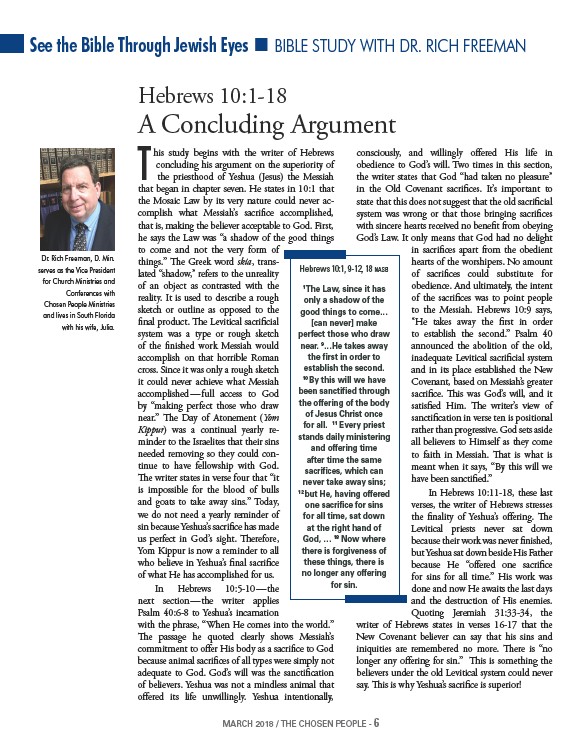
Dr. Rich Freeman, D. Min.
serves as the Vice President
for Church Ministries and
Conferences with
Chosen People Ministries
and lives in South Florida
with his wife, Julia.
Hebrews 10:1, 9-12, 18 NASB
1The Law, since it has
only a shadow of the
good things to come…
can never make
perfect those who draw
near. 9…He takes away
the first in order to
establish the second.
10 By this will we have
been sanctified through
the offering of the body
of Jesus Christ once
for all. 11 Every priest
stands daily ministering
and offering time
after time the same
sacrifices, which can
never take away sins;
12 but He, having offered
one sacrifice for sins
for all time, sat down
at the right hand of
God, … 18 Now where
there is forgiveness of
these things, there is
no longer any offering
for sin.