Rosinweed
Florida has two native Silphium species,
both with robust foliage and ��owers.
The traditional common name for these
plants is rosinweed, but to eliminate any
misconception that these beautiful plants
are weeds, new common names were
adopted. Starry rosinweed (Silphium
astericus) occurs in ��atwoods, sandhills
and disturbed areas in the Panhandle and
the western central peninsula south to
Lee County. Bigleaf rosinweed (Silphium
compositum) occurs in ��atwoods in the
Panhandle and northern counties south to
Pasco County.
Description
Starry rosinweed is a perennial that may
die back in the winter, particularly if cold.
It sports new foliage in the spring and
can produce ��owers from mid-spring
through early fall, and even through winter
if temperatures are mild. The ��owering
stems can reach 3 to 5 feet, with plants
about 2 feet across. The lance-shaped,
toothed leaves occur throughout the stem
to the ��owering scapes, where the stems
branch to support many ��owering heads.
The 2-inch ��owerheads have yellow
ray petals and disks. This species is
especially loved, because it blooms over
a long period of time.
Bigleaf rosinweed is also a perennial, but
does die back in the winter. It emerges in
spring with very unique basal leaves —
they are almost round, deeply dissected,
dark green, red-veined and 4 to 12 inches
across. The ��owering stems can reach 6
feet and have a few tiny leaves scattered
up the stem, which branches near the
top. Flowers are slightly smaller than
Starry rosinweed, with yellow ray petals
surrounding reddish disks, and bloom
toward the end of summer. Because the
stems are not leafy and have ��owers
only at the top, place plants where
the beautiful basal foliage can also be
appreciated.
Planting
Both species can be found in nurseries in
1-gallon containers, but Bigleaf rosinweed
is not widely available.
Seeds
Starry rosinweed seeds are commercially
available; you also can collect your
own when ��owerheads are dry. Break
them apart to separate the seeds. As
perennials, both species persist in the
landscape and can reseed on their own.
For best results, plant seeds shortly after
collection and keep the soil surface moist.
Germination occurs in about 3 weeks.
For faster germination, cold-stratify the
seed by keeping it moist and refrigerated
in planting media for 30 days. Seed will
begin to sprout in 4 days and complete
germination in 2 weeks.
Plants
Space plants about 2 feet apart. Because
both species can tolerate some drought,
water deeply and thoroughly to wet
the soil at least 7 inches down until the
plant is established, but only as often as
needed.
Care
When established in
the right soil, plants
should not need extra
water, but watch for
extra-long droughts,
especially in the spring, and water as
needed. Plants can be cut back after
��owering if desired. On Starry rosinweed,
cut the ��owering portion only, leaving the
leafy stems. Cut back Bigleaf rosinweed
to its basal leaves.
Site conditions
Although the natural range of Starry
rosinweed is the west side of the
peninsula, it performs well through much
of the state. It is fairly drought-resistant,
and also does well in moist soils. Full
sun to partial shade is needed for good
��owering.
Bigleaf rosinweed is even more drought
tolerant than Starry rosinweed and does
well in dry, sandy soils. It also tolerates
moist, well-drained soils, but may grow
taller under those conditions. Full sun is
needed for best ��owering.
Hardiness zones
Starry rosinweed and Bigleaf rosinweed
are suited for zones 8a–10b.
��������������������������������������
Both species are good attractors
of butter��ies, native bees and other
pollinators, and birds will eat the
seeds.
The stems contain a gummy or
resinous substance, and Native
Americans chewed stems to clean
their teeth. Cherokees also used the
plants medicinally.
3–6 ft
Nectar
Since both species of
Silphium occur north
to the Mid-Atlantic
CAUTION
States, it is important
to purchase plants that
were propagated from
Florida progeny for best performance.
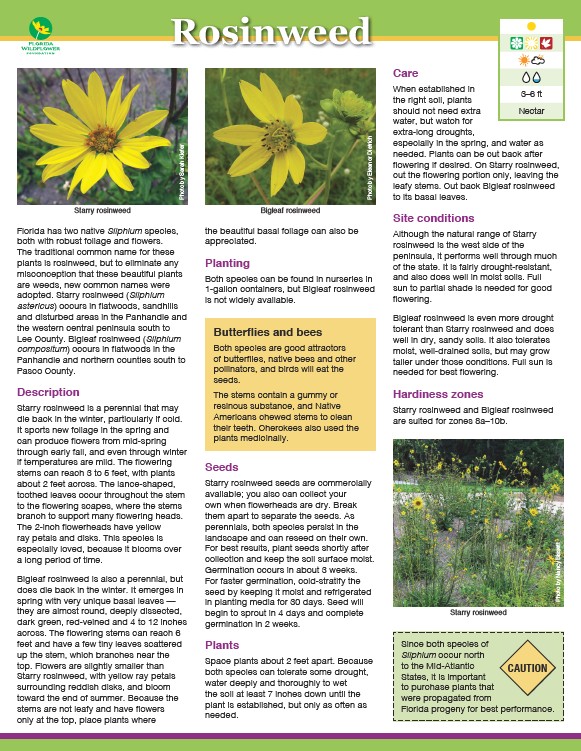
Photo by Sarah Kiefer
Starry rosinweed
Photo by Eleanor Dietrich
Bigleaf rosinweed
Photo by Nancy Bissett
Starry rosinweed