Fighting blindness w ith gene therapy
10 | DOCTOR GATOR
Gene therapy to treat symptoms of Pompe
disease found safe in first human trial
A gene therapy that treats respiratory problems in early-onset Pompe disease was shown to be safe during
its first human trial, UF Health researchers have found. The inherited disease causes a complex sugar to
accumulate in cells, leading to abnormal function in muscles and nerve cells.
The therapy uses a harmless adeno-associated virus to deliver a functional copy of the affected gene to
muscle cells in the diaphragm of patients who have respiratory troubles. Nine patients completed a trial
that found the therapy agent produced no adverse effects and improved respiratory function in the study
participants, said Barry J. Byrne, MD, PhD, director of the UF Powell Gene Therapy Center and a pediatrics
professor in the UF College of Medicine. The findings were published recently in the journal Human Gene
Therapy Clinical Development.
One in nine U.S. men are infected
with oral human papillomavirus
One in nine, or 11 million, U.S. men are infected with oral human
papillomavirus, or HPV, a new study by UF researchers finds. The study,
led by Ashish Deshmukh, PhD, an assistant professor in the department of
health services research, management and policy in the UF College of Public
Health and Health Professions, appeared in the Annals of Internal Medicine in
October. The study found that men are seven times more likely to be infected
with cancer-causing oral HPV strains like HPV type 16, with men ages 50 to 69
at highest risk. Deshmukh said the study raises important issues as current
HPV vaccination rates among men remain low.
UF research opens new avenue for
treatment of Alzheimer’s disease
UF neuroscientists have validated a potential pathway to halt the progression of Alzheimer’s
disease. Protein pieces called amyloid beta, or Abeta, play a role in triggering Alzheimer’s
disease, and scientists say the accumulation of Abeta 42 is key in promoting the disease.
A class of compounds developed to treat Alzheimer’s disease known as gamma-secretase
modulators have been shown to lower levels of Abeta 42 but raise levels of shorter Abeta
peptides. The researchers report the Abeta peptides were not toxic in two animal models
and were protective from the toxic effects of Abeta 42. The findings hold the potential for a
drug therapy to stop Alzheimer’s progression to be tested in humans.
RESEARCH
ROUNDUP
By DOUG BENNETT
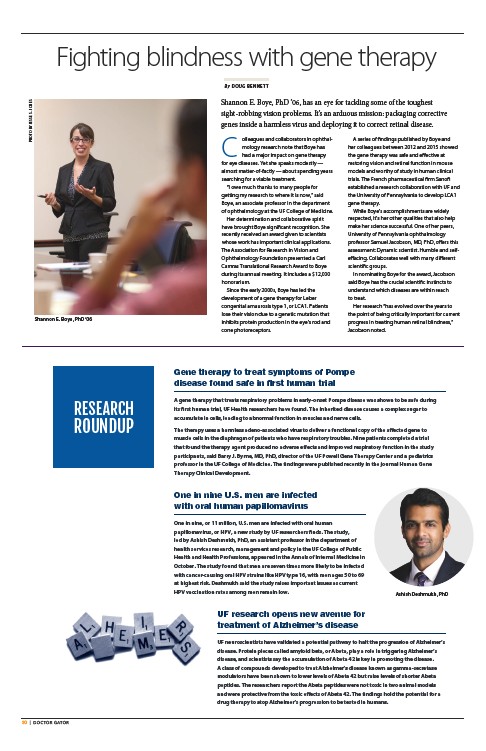
Shannon E. Boye, PhD ’06, has an eye for tackling some of the toughest
sight-robbing vision problems. It’s an arduous mission: packaging corrective
genes inside a harmless virus and deploying it to correct retinal disease.
C olleagues and collaborators in ophthalmology
research note that Boye has
had a major impact on gene therapy
for eye diseases. Yet she speaks modestly —
almost matter-of-factly — about spending years
searching for a viable treatment.
“I owe much thanks to many people for
getting my research to where it is now,” said
Boye, an associate professor in the department
of ophthalmology at the UF College of Medicine.
Her determination and collaborative spirit
have brought Boye significant recognition. She
recently received an award given to scientists
whose work has important clinical applications.
The Association for Research in Vision and
Ophthalmology Foundation presented a Carl
Camras Translational Research Award to Boye
during its annual meeting. It includes a $12,000
honorarium.
Since the early 2000s, Boye has led the
development of a gene therapy for Leber
congenital amaurosis type 1, or LCA1. Patients
lose their vision due to a genetic mutation that
inhibits protein production in the eye’s rod and
cone photoreceptors.
A series of findings published by Boye and
her colleagues between 2012 and 2015 showed
the gene therapy was safe and effective at
restoring vision and retinal function in mouse
models and worthy of study in human clinical
trials. The French pharmaceutical firm Sanofi
established a research collaboration with UF and
the University of Pennsylvania to develop LCA1
gene therapy.
While Boye’s accomplishments are widely
respected, it’s her other qualities that also help
make her science successful. One of her peers,
University of Pennsylvania ophthalmology
professor Samuel Jacobson, MD, PhD, offers this
assessment: Dynamic scientist. Humble and selfeffacing.
Collaborates well with many different
scientific groups.
In nominating Boye for the award, Jacobson
said Boye has the crucial scientific instincts to
understand which diseases are within reach
to treat.
Her research “has evolved over the years to
the point of being critically important for current
progress in treating human retinal blindness,”
Jacobson noted.
Shannon E. Boye, PhD '06
Ashish Deshmukh, PhD
PHOTO BY JESSE S. JONES