Riding the
Rails,
Western DressageStyle
������������������������������������������������������������������������
If I wanted to ride in Western Pleasure, I wouldn’t be at a Western Dressage
show! So, why have rail classes here? Well, there are lots of reasons. First,
Western Dressage rail classes offer an opportunity for riders to introduce
their horses to the arena in the comfort of a group setting before having to
enter alone. Western Dressage promotes a leveled training system beginning
with small steps and moving up a challenge at a time. Therefore, the rail
classes are included for you to use as part of your training process. The rail
classes offered in Western Dressage focus on different goals than Western
Pleasure. Let’s look at Western Dressage’s rail classes one at a time and
keep in mind that you can substitute saddle gait for jog anytime when considering
gaited horses as all these classes can be offered for gaited horses:
Suitability:
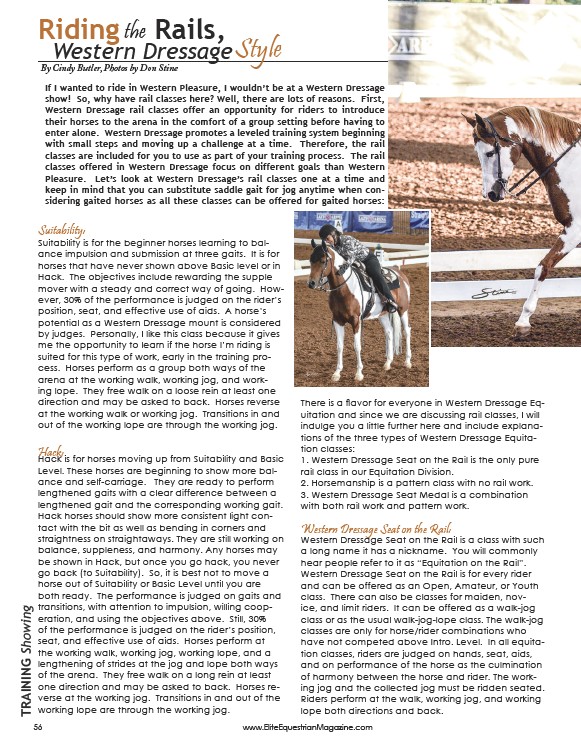
Suitability is for the beginner horses learning to balance
impulsion and submission at three gaits. It is for
horses that have never shown above Basic level or in
Hack. The objectives include rewarding the supple
mover with a steady and correct way of going. However,
30% of the performance is judged on the rider’s
position, seat, and effective use of aids. A horse’s
potential as a Western Dressage mount is considered
by judges. Personally, I like this class because it gives
me the opportunity to learn if the horse I’m riding is
suited for this type of work, early in the training process.
Horses perform as a group both ways of the
arena at the working walk, working jog, and working
lope. They free walk on a loose rein at least one
direction and may be asked to back. Horses reverse
at the working walk or working jog. Transitions in and
out of the working lope are through the working jog.
Hack:
Hack is for horses moving up from Suitability and Basic
Level. These horses are beginning to show more balance
and self-carriage. They are ready to perform
lengthened gaits with a clear difference between a
lengthened gait and the corresponding working gait.
Hack horses should show more consistent light contact
with the bit as well as bending in corners and
straightness on straightaways. They are still working on
balance, suppleness, and harmony. Any horses may
be shown in Hack, but once you go hack, you never
go back (to Suitability). So, it is best not to move a
horse out of Suitability or Basic Level until you are
both ready. The performance is judged on gaits and
transitions, with attention to impulsion, willing cooperation,
and using the objectives above. Still, 30%
of the performance is judged on the rider’s position,
seat, and effective use of aids. Horses perform at
the working walk, working jog, working lope, and a
lengthening of strides at the jog and lope both ways
of the arena. They free walk on a long rein at least
one direction and may be asked to back. Horses reverse
at the working jog. Transitions in and out of the
working lope are through the working jog.
TRAINING Showing
There is a flavor for everyone in Western Dressage Equitation
and since we are discussing rail classes, I will
indulge you a little further here and include explanations
of the three types of Western Dressage Equitation
classes:
1. Western Dressage Seat on the Rail is the only pure
rail class in our Equitation Division.
2. Horsemanship is a pattern class with no rail work.
3. Western Dressage Seat Medal is a combination
with both rail work and pattern work.
Western Dressage Seat on the Rail:
Western Dressage Seat on the Rail is a class with such
a long name it has a nickname. You will commonly
hear people refer to it as “Equitation on the Rail”.
Western Dressage Seat on the Rail is for every rider
and can be offered as an Open, Amateur, or Youth
class. There can also be classes for maiden, novice,
and limit riders. It can be offered as a walk-jog
class or as the usual walk-jog-lope class. The walk-jog
classes are only for horse/rider combinations who
have not competed above Intro. Level. In all equitation
classes, riders are judged on hands, seat, aids,
and on performance of the horse as the culmination
of harmony between the horse and rider. The working
jog and the collected jog must be ridden seated.
Riders perform at the walk, working jog, and working
lope both directions and back.
56 www.EliteEquestrianMagazine.com
/www.EliteEquestrianMagazine.com