THE SHOFAR
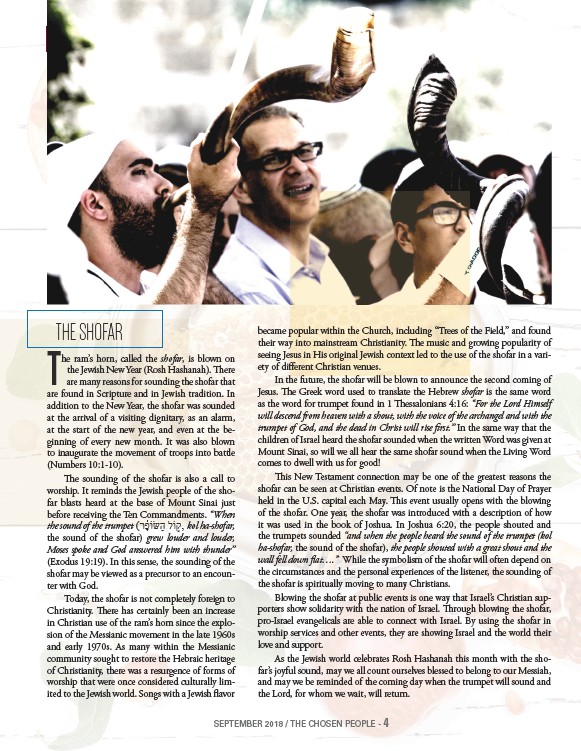
The ram’s horn, called the shofar, is blown on
the Jewish New Year (Rosh Hashanah). There
are many reasons for sounding the shofar that
are found in Scripture and in Jewish tradition. In
addition to the New Year, the shofar was sounded
at the arrival of a visiting dignitary, as an alarm,
at the start of the new year, and even at the beginning
of every new month. It was also blown
to inaugurate the movement of troops into battle
(Numbers 10:1-10).
The sounding of the shofar is also a call to
worship. It reminds the Jewish people of the shofar
blasts heard at the base of Mount Sinai just
before receiving the Ten Commandments. “When
the sound of the trumpet (����������������������������, kol ha-shofar,
the sound of the shofar) grew louder and louder,
Moses spoke and God answered him with thunder”
(Exodus 19:19). In this sense, the sounding of the
shofar may be viewed as a precursor to an encounter
with God.
Today, the shofar is not completely foreign to
Christianity. There has certainly been an increase
in Christian use of the ram’s horn since the explosion
of the Messianic movement in the late 1960s
and early 1970s. As many within the Messianic
community sought to restore the Hebraic heritage
of Christianity, there was a resurgence of forms of
worship that were once considered culturally limited
to the Jewish world. Songs with a Jewish flavor
became popular within the Church, including “Trees of the Field,” and found
their way into mainstream Christianity. The music and growing popularity of
seeing Jesus in His original Jewish context led to the use of the shofar in a variety
of different Christian venues.
In the future, the shofar will be blown to announce the second coming of
Jesus. The Greek word used to translate the Hebrew shofar is the same word
as the word for trumpet found in 1 Thessalonians 4:16: “For the Lord Himself
will descend from heaven with a shout, with the voice of the archangel and with the
trumpet of God, and the dead in Christ will rise first.” In the same way that the
children of Israel heard the shofar sounded when the written Word was given at
Mount Sinai, so will we all hear the same shofar sound when the Living Word
comes to dwell with us for good!
This New Testament connection may be one of the greatest reasons the
shofar can be seen at Christian events. Of note is the National Day of Prayer
held in the U.S. capital each May. This event usually opens with the blowing
of the shofar. One year, the shofar was introduced with a description of how
it was used in the book of Joshua. In Joshua 6:20, the people shouted and
the trumpets sounded “and when the people heard the sound of the trumpet (kol
ha-shofar, the sound of the shofar), the people shouted with a great shout and the
wall fell down flat….” While the symbolism of the shofar will often depend on
the circumstances and the personal experiences of the listener, the sounding of
the shofar is spiritually moving to many Christians.
Blowing the shofar at public events is one way that Israel’s Christian supporters
show solidarity with the nation of Israel. Through blowing the shofar,
pro-Israel evangelicals are able to connect with Israel. By using the shofar in
worship services and other events, they are showing Israel and the world their
love and support.
As the Jewish world celebrates Rosh Hashanah this month with the shofar’s
joyful sound, may we all count ourselves blessed to belong to our Messiah,
and may we be reminded of the coming day when the trumpet will sound and
the Lord, for whom we wait, will return.
SEPTEMBER 2018 / THE CHOSEN PEOPLE - 4