THE NEW
TESTAMENT,
CHRISTMAS,
AND
HANUKKAH
Celebrating
the Season!
FROM THE PRESIDENT
DECEMBER 2018 / THE CHOSEN PEOPLE - 2
Dear friend,
Shalom and happy holidays! I am sure you
are looking forward to celebrating the two great
holidays observed in December. On Hanukkah,
we focus on the rededication of the Temple during
the days of the Maccabees, a family of Jewish
warriors who saved the Jewish people from the
Greek leader Antiochus Epiphanes. Christmas, of
course, points us to the redemption of both Jews
and Gentiles through the One who was born to be
the Savior of the world.
We see similar patterns in both holidays,
including themes of light, generosity, deliverance,
and giving glory to God.
HANUKKAH AND CHRISTMAS:
THE CONNECTION?
I also see the connection between Hanukkah
and Christmas in the ways that the stories
complement one another. After all, if Antiochus
Epiphanes had turned the Jewish people into idolworshipping
Greeks who tossed out the Bible and
embraced Greek philosophies, then the Jewish
people could very well have disappeared. If that
had happened, why would anyone be looking for
a Jewish Messiah? And who would understand the
prophecies in the Hebrew Scriptures that paved a
path through history, enabling Jewish
people to identify the true Messiah?
All would have been lost if this
small band of priestly zealots had not
overthrown the Greeks.
Stated simply: Without Hanukkah,
there would be no Christmas!
The Savior of the world did
not enter earth’s atmosphere unannounced
or pop onto the scene
through some mystical vortex that
would make any New Ager jealous!
Rather, His birthplace, parents, tribe,
and even the timing of His birth were
predicted with extraordinary specificity, which allowed
us to recognize Him as the Son of God and
Messiah of the Jewish people.
Jesus was Jewish! He was born a Jew, both of
His parents were Jewish, He lived a Jewish life,
celebrated Jewish holidays such as Passover and
the Feast of Tabernacles, and He lived a perfect
life according to the Torah (Law). He grew up in
the land given to the Jewish people, and when
the moment came for the prophecy of His death
to be fulfilled (Isaiah 53), He went to the cross
without complaint, with love for His people who,
for the most part, had rejected Him. He became
the Savior and quintessential Passover lamb for all
who, by faith, trusted in the blood of the Messiah,
painted by grace on the doorposts of their hearts.
There literally would be no Christmas without
Hanukkah, as there would be no Messiah
without the Jewish people.
EARLY FAITH DISCOVERIES
I remember the first time I read the New
Testament. I had previously thought this thin
volume, compared to the Older Testament, was
the fountainhead of antisemitism. I grew up
believing that Jewish people were not supposed
to read this book. Yet, one day I found a New
Testament and began reading it. It struck me
with the simplicity of its message and the love and
kindness of Jesus. I quickly understood that He
was Jewish, and I was fixated on His celebration of
the Jewish holidays—as this is one of the ways we,
as Jews, define ourselves. We celebrate Passover,
not Easter, and Hanukkah, not Christmas. After
I finished reading the Gospels for the first time,
I came face to face with a Jewish book and a
Jewish Messiah that was consistent with the Old
Testament and that crushed my prejudices against
the New Testament.
After reading “the book,” I knew I had to
decide. Although as a Jewish person I was raised
to reject Jesus, how could I do that after realizing
that He fulfilled the prophecies predicted of the
Messiah? I knew in the depth of my soul that if
I did not believe in Jesus, I could never believe in
anything! I was that convinced.
And so I accepted Jesus as my Messiah. For
a moment, I feared I would wake up the next
morning and find myself transformed into a
Gentile, but the opposite was true. I never felt so
Jewish in my entire life.
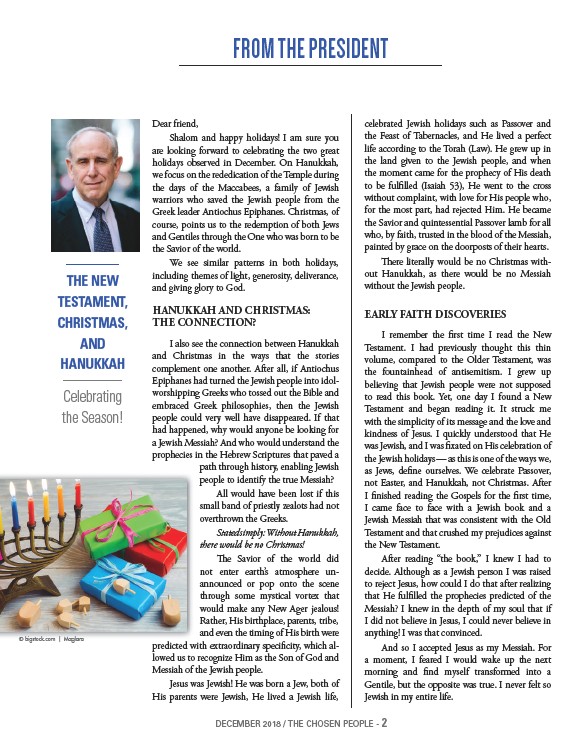
© bigstock.com | Maglara
/bigstock.com