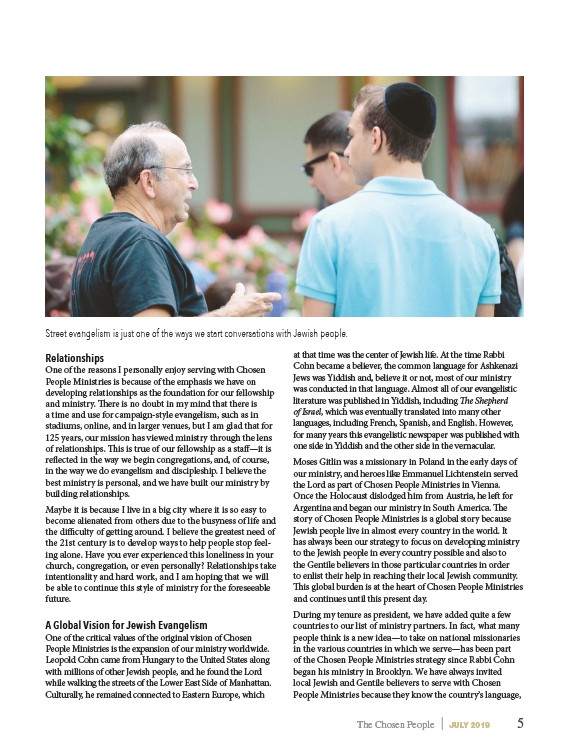
Street evangelism is just one of the ways we start conversations with Jewish people.
at that time was the center of Jewish life. At the time Rabbi
Cohn became a believer, the common language for Ashkenazi
Jews was Yiddish and, believe it or not, most of our ministry
was conducted in that language. Almost all of our evangelistic
literature was published in Yiddish, including The Shepherd
of Israel, which was eventually translated into many other
languages, including French, Spanish, and English. However,
for many years this evangelistic newspaper was published with
one side in Yiddish and the other side in the vernacular.
Moses Gitlin was a missionary in Poland in the early days of
our ministry, and heroes like Emmanuel Lichtenstein served
the Lord as part of Chosen People Ministries in Vienna.
Once the Holocaust dislodged him from Austria, he left for
Argentina and began our ministry in South America. The
story of Chosen People Ministries is a global story because
Jewish people live in almost every country in the world. It
has always been our strategy to focus on developing ministry
to the Jewish people in every country possible and also to
the Gentile believers in those particular countries in order
to enlist their help in reaching their local Jewish community.
This global burden is at the heart of Chosen People Ministries
and continues until this present day.
During my tenure as president, we have added quite a few
countries to our list of ministry partners. In fact, what many
people think is a new idea—to take on national missionaries
in the various countries in which we serve—has been part
of the Chosen People Ministries strategy since Rabbi Cohn
began his ministry in Brooklyn. We have always invited
local Jewish and Gentile believers to serve with Chosen
People Ministries because they know the country’s language,
The Chosen People | JULY 2019 5
Relationships
One of the reasons I personally enjoy serving with Chosen
People Ministries is because of the emphasis we have on
developing relationships as the foundation for our fellowship
and ministry. There is no doubt in my mind that there is
a time and use for campaign-style evangelism, such as in
stadiums, online, and in larger venues, but I am glad that for
125 years, our mission has viewed ministry through the lens
of relationships. This is true of our fellowship as a staff—it is
reflected in the way we begin congregations, and, of course,
in the way we do evangelism and discipleship. I believe the
best ministry is personal, and we have built our ministry by
building relationships.
Maybe it is because I live in a big city where it is so easy to
become alienated from others due to the busyness of life and
the difficulty of getting around. I believe the greatest need of
the 21st century is to develop ways to help people stop feeling
alone. Have you ever experienced this loneliness in your
church, congregation, or even personally? Relationships take
intentionality and hard work, and I am hoping that we will
be able to continue this style of ministry for the foreseeable
future.
A Global Vision for Jewish Evangelism
One of the critical values of the original vision of Chosen
People Ministries is the expansion of our ministry worldwide.
Leopold Cohn came from Hungary to the United States along
with millions of other Jewish people, and he found the Lord
while walking the streets of the Lower East Side of Manhattan.
Culturally, he remained connected to Eastern Europe, which