42 www.EliteEquestrianMagazine.com
Continued...
EQUINE Health
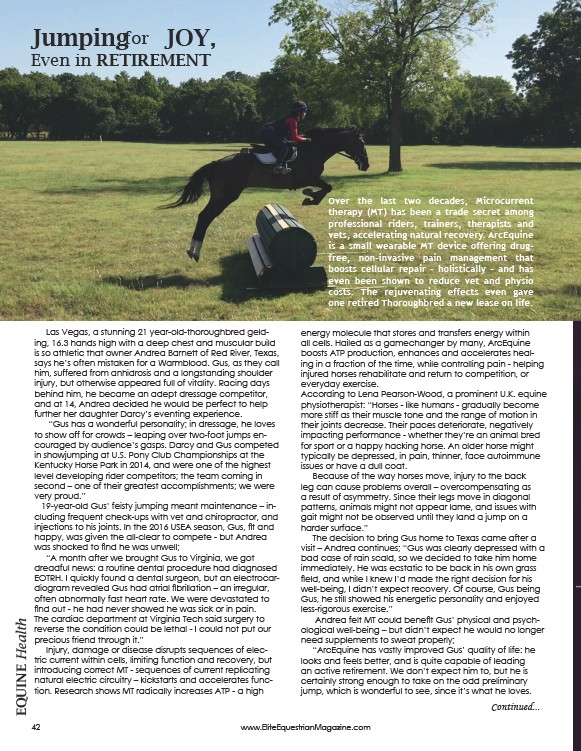
Jumping for
JOY,
Even in RETIREMENT
Over the last two decades, Microcurrent
therapy (MT) has been a trade secret among
professional riders, trainers, therapists and
vets, accelerating natural recovery. ArcEquine
is a small wearable MT device offering drugfree,
non-invasive pain management that
boosts cellular repair – holistically – and has
even been shown to reduce vet and physio
costs. The rejuvenating effects even gave
one retired Thoroughbred a new lease on life.
Las Vegas, a stunning 21 year-old-thoroughbred gelding,
16.3 hands high with a deep chest and muscular build
is so athletic that owner Andrea Barnett of Red River, Texas,
says he’s often mistaken for a Warmblood. Gus, as they call
him, suffered from anhidrosis and a longstanding shoulder
injury, but otherwise appeared full of vitality. Racing days
behind him, he became an adept dressage competitor,
and at 14, Andrea decided he would be perfect to help
further her daughter Darcy’s eventing experience.
“Gus has a wonderful personality; in dressage, he loves
to show off for crowds – leaping over two-foot jumps encouraged
by audience’s gasps. Darcy and Gus competed
in showjumping at U.S. Pony Club Championships at the
Kentucky Horse Park in 2014, and were one of the highest
level developing rider competitors; the team coming in
second – one of their greatest accomplishments; we were
very proud.”
19-year-old Gus’ feisty jumping meant maintenance – including
frequent check-ups with vet and chiropractor, and
injections to his joints. In the 2016 USEA season, Gus, fit and
happy, was given the all-clear to compete - but Andrea
was shocked to find he was unwell;
“A month after we brought Gus to Virginia, we got
dreadful news: a routine dental procedure had diagnosed
EOTRH. I quickly found a dental surgeon, but an electrocardiogram
revealed Gus had atrial fibrillation – an irregular,
often abnormally fast heart rate. We were devastated to
find out - he had never showed he was sick or in pain.
The cardiac department at Virginia Tech said surgery to
reverse the condition could be lethal - I could not put our
precious friend through it.”
Injury, damage or disease disrupts sequences of electric
current within cells, limiting function and recovery, but
introducing correct MT - sequences of current replicating
natural electric circuitry – kickstarts and accelerates function.
Research shows MT radically increases ATP - a high
energy molecule that stores and transfers energy within
all cells. Hailed as a gamechanger by many, ArcEquine
boosts ATP production, enhances and accelerates healing
in a fraction of the time, while controlling pain - helping
injured horses rehabilitate and return to competition, or
everyday exercise.
According to Lena Pearson-Wood, a prominent U.K. equine
physiotherapist: “Horses - like humans - gradually become
more stiff as their muscle tone and the range of motion in
their joints decrease. Their paces deteriorate, negatively
impacting performance - whether they’re an animal bred
for sport or a happy hacking horse. An older horse might
typically be depressed, in pain, thinner, face autoimmune
issues or have a dull coat.
Because of the way horses move, injury to the back
leg can cause problems overall – overcompensating as
a result of asymmetry. Since their legs move in diagonal
patterns, animals might not appear lame, and issues with
gait might not be observed until they land a jump on a
harder surface.”
The decision to bring Gus home to Texas came after a
visit – Andrea continues; “Gus was clearly depressed with a
bad case of rain scald, so we decided to take him home
immediately. He was ecstatic to be back in his own grass
field, and while I knew I’d made the right decision for his
well-being, I didn’t expect recovery. Of course, Gus being
Gus, he still showed his energetic personality and enjoyed
less-rigorous exercise.”
Andrea felt MT could benefit Gus’ physical and psych-
ological well-being – but didn’t expect he would no longer
need supplements to sweat properly;
“ArcEquine has vastly improved Gus’ quality of life: he
looks and feels better, and is quite capable of leading
an active retirement. We don’t expect him to, but he is
certainly strong enough to take on the odd preliminary
jump, which is wonderful to see, since it’s what he loves.
/www.EliteEquestrianMagazine.com