TRAINING & TACK
BIT Sense
TRAINING & Showing
Story By Alessandra Deerinck,
Human Horse Sensing
and Darren Stoner
In order to interact with horses, people have trained them for many purposes,
but it is important to keep in mind that equines do not just limit
their perception to what we want to be our instruction to them. Whether
we want it or not horses perceive every part of our behavior, and anything
that happens at the same time in the surrounding area. Learning
to be aware of this fact, and to manage the whole scope of our behavior
can let us have a more detailed and effective communication with
the horse, especially when we are talking about a critical subject as bits.
head in unnatural postures, to escape the discomfort, and
by doing so they can end up putting strain on other sites
of their body, or even cause postural lameness. Some of
the most evident causes of instances where horses show
discomfort from the presence of the bit in their mouth
are tight nose bands (to keep the horse from opening his
mouth), or the pressure that is inflicted on the poll where
the bridle sits, caused by the tension of the bridle itself. This
has been a practice for a long time, aimed to regulate the
length of the bridle, to make the bit cause wrinkles on the
side of the lips to “keep” the contact, disregarding the fact
that teeth have sharp surfaces that can cause ulceration if
touching the oral mucosal surfaces under the wrinkles.
‘For the purpose of augmenting the efficiency of the
bit, in addition to the “wrinkle rule”, metal and plastic have
been shaped in many ways to purposefully put pressure on
different sites of the mouth and the head. Taking a different
perspective can give us the chance to actually benefit
the horse, instead of inflicting pain. In fact, if we want to
keep using bits, they could be purposefully shaped not to
cause pain, and also be handled in a detailed manner to
best convey our communication.’
During an interaction between individuals, the position
relative to each other determines which senses are
involved in perceiving communication. The relationship
between human and horse happens through a communication
between two individuals of different species.
Horses do not understand spoken language, unless
they were trained for some specific spoken cue. Sight
and hearing are the prevalent channels of perception
from a distance, touch and taste become possible
when we are close, and smell can be involved in in
both situations. Riding implies a position where the
horse cannot see the rider, but perceives his communication
mainly by the sense of touch. The horse feels
a rider’s whole body sitting on his back. The rider is also
holding the reins that are attached to the bit, which
gives the possibility for a contact that can be very
refined in directing the horse’s head.
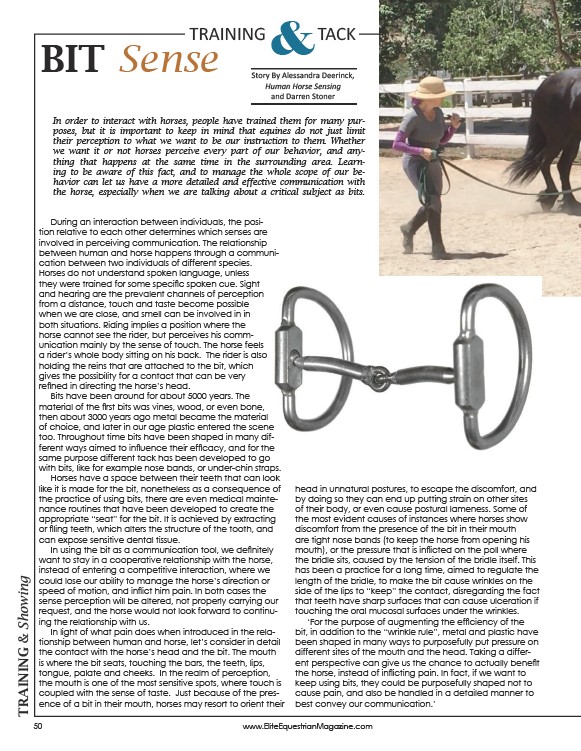
Bits have been around for about 5000 years. The
material of the first bits was vines, wood, or even bone,
then about 3000 years ago metal became the material
of choice, and later in our age plastic entered the scene
too. Throughout time bits have been shaped in many different
ways aimed to influence their efficacy, and for the
same purpose different tack has been developed to go
with bits, like for example nose bands, or under-chin straps.
Horses have a space between their teeth that can look
like it is made for the bit, nonetheless as a consequence of
the practice of using bits, there are even medical maintenance
routines that have been developed to create the
appropriate “seat” for the bit. It is achieved by extracting
or filing teeth, which alters the structure of the tooth, and
can expose sensitive dental tissue.
In using the bit as a communication tool, we definitely
want to stay in a cooperative relationship with the horse,
instead of entering a competitive interaction, where we
could lose our ability to manage the horse’s direction or
speed of motion, and inflict him pain. In both cases the
sense perception will be altered, not properly carrying our
request, and the horse would not look forward to continuing
the relationship with us.
In light of what pain does when introduced in the relationship
between human and horse, let’s consider in detail
the contact with the horse’s head and the bit. The mouth
is where the bit seats, touching the bars, the teeth, lips,
tongue, palate and cheeks. In the realm of perception,
the mouth is one of the most sensitive spots, where touch is
coupled with the sense of taste. Just because of the presence
of a bit in their mouth, horses may resort to orient their
50 www.EliteEquestrianMagazine.com
/www.EliteEquestrianMagazine.com