Saddle Fit
and
Western Saddles
By Jochen Schleese, CMS, CSFT, CSE
©2018 Saddlefit 4 Life ® All Rights Reserved
My principle on saddle fitting – any model or discipline – is to fit the saddle
firstly to the rider and ensure he/she is sitting correctly, balanced, and comfortably,
as well as fit it to the horse’s conformation. Regardless which saddle
e
– dressage, jumping, racing, endurance, speciality saddle, or western saddle
– it has to fit along the lines of these commonly accepted principles. The
saddle must not impact or deform the horse’s back in any way (i.e., negatively
influence the conformation). It should fit into the saddle support area, and
not sit over the shoulder and damage the cartilage, impinge the spinal processes
or ligaments, nor pinch and numb the nerves permanently - in other
y
words, to protect horse and rider from long term back damage – regardless of
the saddle. For the rider, the basics are that the back shouldn’t ache, the hips
shouldn’t hurt and feel pulled apart, the knees shouldn’t bruise, and the rider
should sit in proper balance to achieve riding in harmony.
Most western saddles are still built to the principles of the
last century where they were working saddles used by
cowboys. Most western saddles built in the last 40 to 50
years are still built for the male rider, but it seems that the
manufacturers may have forgotten what was done in the
old days – when the cowboy came from a cattle drive after
being 3-4 months in the countryside, the horse was usually
put out to pasture for a few days to rest. It may have
gotten new shoes, and got a thorough grooming, while the
saddle itself was completely overhauled. The panel sheepskin
was pulled off and replaced, and the bottom of the
tree was reshaped to the horse’s back with new sheepskin.
He was then ready for the next cattle drive with a newly
properly fitted saddle.
The same applied to the army saddles – in the cavalry the
officer was taught how to shift the stuffing around through
the bottom of the saddle which was made of a serge
panel. The stuffing was horsehair and deer hair and could
be adjusted as much as 4-5 times per year. I have yet to
see a modern western saddle refitted in any way – so they
either fit well or they really don’t.
So what does this mean? Both the working riders – cowboy
or soldier – realized proper equipment and properly fitted
saddles allowed them to do their jobs while protecting their
horses.
Today we have mass-produced western saddles (except
perhaps those generally deemed ‘custom’) still made
mainly for a traditional male cowboy, (even though statistics
show that 75% of western riders are female), and most
are made and sold without proper fitting to the horse. This is
why we introduced the western and English trail saddles to
our line – to bring back old traditions but to fit new clientele
(women) who want to enjoy recreational rides in a more
secure seat than the English saddle can offer.
The average weight of a ‘real’ western saddle is 45-50
pounds which is an effort to lift, so we developed a lighter
model approximately 25-27 lbs. We use our patented
TRAINING & Showing
s
r
AdapTree® in a remodeled version designed for pleasure
trail riding and which can be adjusted in the panels that
are attached to the bars. It is also completely adaptable
for the rider with its adjustable seat – which makes it unique
in the western world in that it becomes useable for many
different riders and many different horses. Everyone who
has sat in it has absolutely fallen in love with it.
64 www.EliteEquestrianMagazine.com
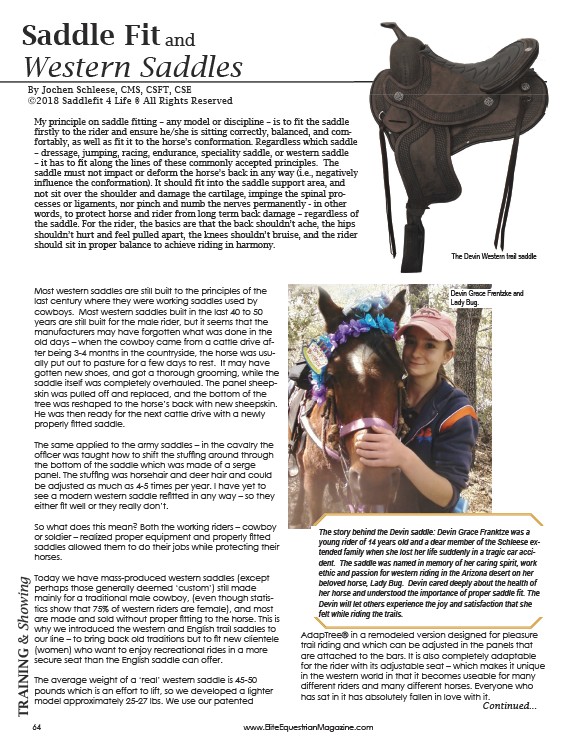
The Devin Western trail saddle
Devin Grace Frantzke and
Lady Bug.
The story behind the Devin saddle: Devin Grace Franktze was a
young rider of 14 years old and a dear member of the Schleese extended
family when she lost her life suddenly in a tragic car accident.
The saddle was named in memory of her caring spirit, work
ethic and passion for western riding in the Arizona desert on her
beloved horse, Lady Bug. Devin cared deeply about the health of
her horse and understood the importance of proper saddle fit. The
Devin will let others experience the joy and satisfaction that she
felt while riding the trails.
Continued...
/www.EliteEquestrianMagazine.com