right. Armed with false arguments, he is convinced of the
permissibility of earning unlawful wealth. This type of
greed is also unlawful.
Third Type
The third type of greed is found in a person to whom
wealth seems good and he wishes to accumulate it, but
does not earn it in an unlawful way or advance spurious
arguments to justify it. He is content with whatever Allah
has apportioned to him, though he would not mind having
more. This kind of greed is not contemptible since it does
not harm his faith and does not incite him to do anything
haram.
Stinginess is an Evil Trait
The same rule applies to stinginess. Allah says, “And
present in human souls is stinginess” (4:128). Man does
have a propensity for wealth and possessions, but stinginess
itself is not bad as long as it does not prevent one from
discharging his duties (e.g. paying zakat) or incite him
towards the unlawful or reprehensible acts. It would be bad
if a man refuses to pay zakat, does not spend on his family
according to their right, does not give in charity, or lives
like a beggar though Allah has blessed him with wealth out
of stinginess. It is the right of Allah that man be grateful to
Allah by putting what Allah has granted him to proper use.
The Prophet of Allah a said, “Surely, Allah loves to see His
blessings manifest on His servant” (Abu Dawud). Hence,
we exhibit the blessings of Allah on us. Let not one who
is wealthy be seen in public in tattered garments as it is a
form of ingratitude to Allah. The bounties of Allah should
appear in a way that others know that he has been blessed
with these bounties.
Type of Stinginess
One type of stinginess is the habit of fulfilling others’ rights
but to a bare minimum. For instance, a person spends so
sparingly on his household that their meal can be defined
as cheap and plain yet he can afford a much better diet.
This is a type of stinginess that could be classified as
undesirable. However, if there is no violation of rights and
the family is satisfied, and one feels disinclined to spend
more openly, then there is no harm in that. Nevertheless,
this is a type of stinginess that is docile and not harmful to
the faith. Anyhow, we have seen that through some effort,
the radha’il can be controlled but not eradicated. May Allah
give us taufiq to stay away from the radha’il.
بية L رE عA لRا N ة A غRلAالB مIC تعل
��������
����������
����������������
�������� �������� ������������
��������
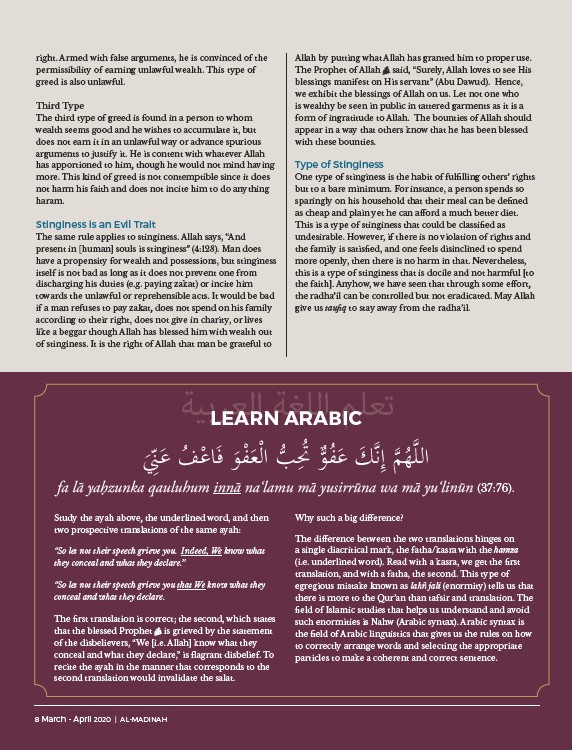
Study the ayah above, the underlined word, and then
two prospective translations of the same ayah:
“So let not their speech grieve you. Indeed, We know what
they conceal and what they declare.”
“So let not their speech grieve you that We know what they
conceal and what they declare.
The first translation is correct; the second, which states
that the blessed Prophet a is grieved by the statement
of the disbelievers, “We i.e. Allah know what they
conceal and what they declare,” is flagrant disbelief. To
recite the ayah in the manner that corresponds to the
second translation would invalidate the salat.
������������������
����������
��������
fa ló yaúzunka qauluhum innó na‘lamu mó yusirrñna wa mó yu‘linñn (37:76).
Why such a big difference?
The difference between the two translations hinges on
a single diacritical mark, the fatha/kasra with the hamza
(i.e. underlined word). Read with a kasra, we get the first
translation, and with a fatha, the second. This type of
egregious mistake known as lahñ jali (enormity) tells us that
there is more to the Qur’an than tafsir and translation. The
field of Islamic studies that helps us understand and avoid
such enormities is Nahw (Arabic syntax). Arabic syntax is
the field of Arabic linguistics that gives us the rules on how
to correctly arrange words and selecting the appropriate
particles to make a coherent and correct sentence.
8 March - April 2020 | AL-MADINAH