FLOORING & HEALTH
Flooring First
Barn design begins at ground level.
By Kim F Miller
Stall flooring isn’t the sexiest subject among the many considerations
in building or updating a barn. But leave it to the last at your peril,
counsels renowned barn architect John Blackburn. As the title of
one of his most popular books, Healthy Stables by Design, suggests,
Blackburn and his team at Blackburn Architects PC prioritize horse
health every step of the way. The owners’ goals for their stable and
the demands of their site are equally important.
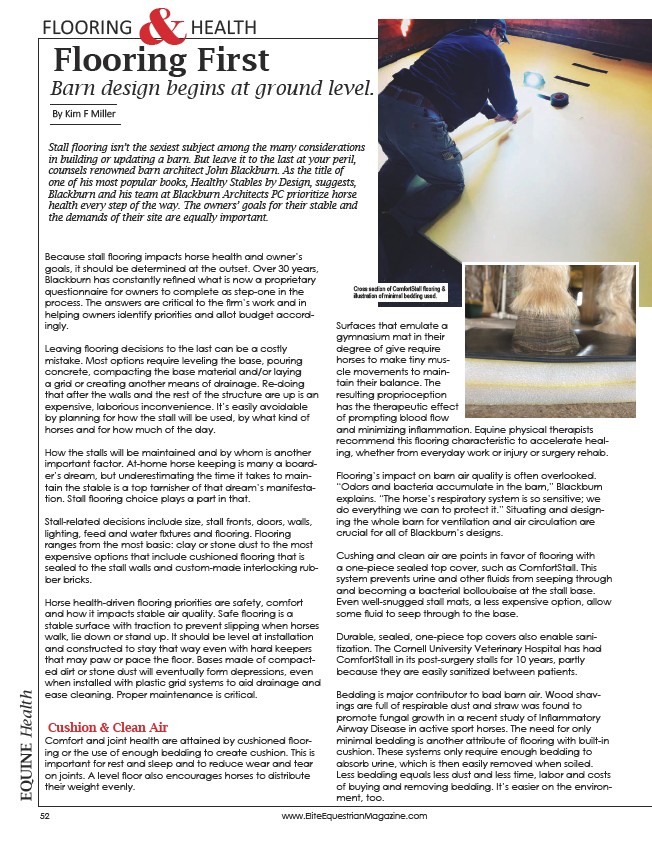
Cross section of ComfortStall flooring &
illustration of minimal bedding used.
Surfaces that emulate a
gymnasium mat in their
degree of give require
horses to make tiny muscle
movements to maintain
their balance. The
resulting proprioception
has the therapeutic effect
of prompting blood flow
and minimizing inflammation. Equine physical therapists
recommend this flooring characteristic to accelerate healing,
whether from everyday work or injury or surgery rehab.
Flooring’s impact on barn air quality is often overlooked.
“Odors and bacteria accumulate in the barn,” Blackburn
explains. “The horse’s respiratory system is so sensitive; we
do everything we can to protect it.” Situating and designing
the whole barn for ventilation and air circulation are
crucial for all of Blackburn’s designs.
Cushing and clean air are points in favor of flooring with
a one-piece sealed top cover, such as ComfortStall. This
system prevents urine and other fluids from seeping through
and becoming a bacterial bolloubaise at the stall base.
Even well-snugged stall mats, a less expensive option, allow
some fluid to seep through to the base.
Durable, sealed, one-piece top covers also enable sanitization.
The Cornell University Veterinary Hospital has had
ComfortStall in its post-surgery stalls for 10 years, partly
because they are easily sanitized between patients.
Bedding is major contributor to bad barn air. Wood shavings
are full of respirable dust and straw was found to
promote fungal growth in a recent study of Inflammatory
Airway Disease in active sport horses. The need for only
minimal bedding is another attribute of flooring with built-in
cushion. These systems only require enough bedding to
absorb urine, which is then easily removed when soiled.
Less bedding equals less dust and less time, labor and costs
of buying and removing bedding. It’s easier on the environment,
too.
EQUINE Health
Because stall flooring impacts horse health and owner’s
goals, it should be determined at the outset. Over 30 years,
Blackburn has constantly refined what is now a proprietary
questionnaire for owners to complete as step-one in the
process. The answers are critical to the firm’s work and in
helping owners identify priorities and allot budget accordingly.
Leaving flooring decisions to the last can be a costly
mistake. Most options require leveling the base, pouring
concrete, compacting the base material and/or laying
a grid or creating another means of drainage. Re-doing
that after the walls and the rest of the structure are up is an
expensive, laborious inconvenience. It’s easily avoidable
by planning for how the stall will be used, by what kind of
horses and for how much of the day.
How the stalls will be maintained and by whom is another
important factor. At-home horse keeping is many a boarder’s
dream, but underestimating the time it takes to maintain
the stable is a top tarnisher of that dream’s manifestation.
Stall flooring choice plays a part in that.
Stall-related decisions include size, stall fronts, doors, walls,
lighting, feed and water fixtures and flooring. Flooring
ranges from the most basic: clay or stone dust to the most
expensive options that include cushioned flooring that is
sealed to the stall walls and custom-made interlocking rubber
bricks.
Horse health-driven flooring priorities are safety, comfort
and how it impacts stable air quality. Safe flooring is a
stable surface with traction to prevent slipping when horses
walk, lie down or stand up. It should be level at installation
and constructed to stay that way even with hard keepers
that may paw or pace the floor. Bases made of compacted
dirt or stone dust will eventually form depressions, even
when installed with plastic grid systems to aid drainage and
ease cleaning. Proper maintenance is critical.
Cushion & Clean Air
Comfort and joint health are attained by cushioned flooring
or the use of enough bedding to create cushion. This is
important for rest and sleep and to reduce wear and tear
on joints. A level floor also encourages horses to distribute
their weight evenly.
52 www.EliteEquestrianMagazine.com
/www.EliteEquestrianMagazine.com