Cross
TRAINING
Horses
����������������������������������������������
2. 3.
Cross - training is a fitness technique known to be used by top human athletes to achieve optimal muscle strength, endurance,
coordination, and gain overall soundness. Equine athletes can benefit from cross training in the same ways.
If we consider the benefits that we can bring to our horses, and to our own skills, we would definitely apply it to our
routine. Cross training can actually add to our horsemanship, by giving us the chance to widen our experience, and
learn to properly communicate with our horse. Some of the horses at Human Horse Sensing have experienced training
and competing in endurance and dressage, but also being part of clinics, ridden in parades, and have done
mounted archery. For the purpose of reaching optimal fitness with cross training, it is not necessary to compete
in the disciplines that are not our choice, just learning how to exercise the horse can be sufficient to achieve the goal.
When competing in a specific sport, a horse has to undergo
a fair amount of homogenous and targeted training,
but this activity pushes repeatedly on the same physical aspects
of the equine body. Any equestrian discipline works
certain muscle groups more than others, and practicing
different ones can eliminate this imbalance.
Bones are dynamic tissues that remodel and change their
structure throughout life according to age, but even more
to the activity and the workload they undergo. The basic
law of bone is that it is always changing and responding to
stress. As a consequence of repetitive strain, micro-damage
occurs within the bone. When this occurs the damaged
cells send signals to remove the damaged bone,
and replace it with healthy tissue. Overtraining causes
micro-damage to happen at a faster rate than the body
can fix, and the repaired tissue can be not as strong as
the original one. Repeated strain to the same area can
severely weaken and damage bones, but changing activities
will shift the stress and will help in keeping athlete horses
sound and healthy. Tendons and ligaments can be seriously
damaged by continuous stress from training, because
they have a slower rate of recovery than bones. They also
lose even more strength with the aging process. These soft
tissues can definitely benefit from cross training.
If we think in terms of physics, and widen our horizon of
the cross training activities, swimming can be a very useful
resource. It is not a traditional equestrian discipline, and
is not an easily accessible resource for everyone, but it
can be a great way for building up muscle without unduly
stressing bones, tendons and ligaments. Swimming relieves
some of the load on the bone structures, while still making
the muscles work, and can also be a good resource when
horses are recovering from injuries.
TRAINING & Showing
Staying within the traditional panorama of the equestrian
sports, a hunter/jumper or endurance horse that is crosstrained
with dressage work will experience increased
suppleness and coordination. Suddenly mile 50 isn’t such
a strain, or that quick turn in a jump-off is more fluid. A
hunter/jumper or a dressage show horse that does some
endurance can better withstand the long shows. An endurance
horse or a dressage horse that gets hacked over
jumps will achieve more skills in getting over occasional
obstacles found on its path.
Tendons and ligaments
can be seriously damaged
by continuous
stress from training
In order to live in the domestic state horses have to adapt
to a situation that is different from their natural one. To cite
just the biggest aspects: they eat hay instead of grass,
they are confined in small spaces, and they are deprived
of social relationships, which are a need for their species.
Equestrian sports are definitely not a natural activity for
horses; furthermore they have no natural interest in being
ridden and competing. When ridden under saddle, they
are carrying the weight of the rider and tack, which adds
to the load on their muscles and bones. Under saddle, they
have to learn to move according to the rider’s needs and
requests, which is also an influence on the load for muscles,
bones, tendons and ligaments. Some disciplines require the
horse to carry his body in an unnatural manner. An example
is the head position in dressage or in some western
54 www.EliteEquestrianMagazine.com
A cross-training
program with horses
can even be twofold
in terms of equine
wellbeing: we can
improve our horse’s fitness,
but also provide
him with some great
mental stimulation.
1.
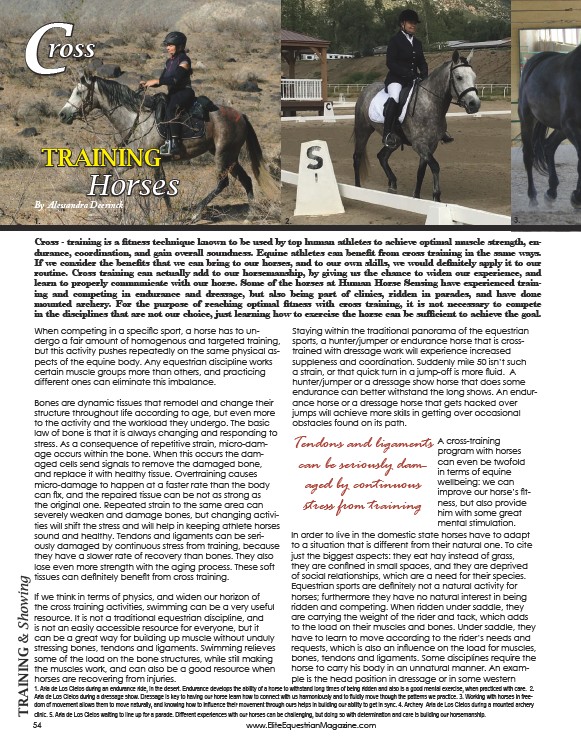
1. Aria de Los Cielos during an endurance ride, in the desert. Endurance develops the ability of a horse to withstand long times of being ridden and also is a good mental exercise, when practiced with care. 2.
Aria de Los Cielos during a dressage show. Dressage is key to having our horse learn how to connect with us harmoniously and to fluidly move though the patterns we practice. 3. Working with horses in freedom
of movement allows them to move naturally, and knowing how to influence their movement through ours helps in building our ability to get in sync. 4. Archery Aria de Los Cielos during a mounted archery
clinic. 5. Aria de Los Cielos waiting to line up for a parade. Different experiences with our horses can be challenging, but doing so with determination and care is building our horsemanship.
/www.EliteEquestrianMagazine.com