ids
Communication:
The Bending Aids
Palm Partnership Training™
Building a Partnership with Your Horse
������������������������
I have been reflecting on the importance of the turning aids
compared to the bending aids a rider uses. This issue is so important,
I would like to revisit our discussion of these aids and
add some clarification.
To review, the turning aids are the outside leg and outside
indirect rein, supported by the inside leg and inside rein.
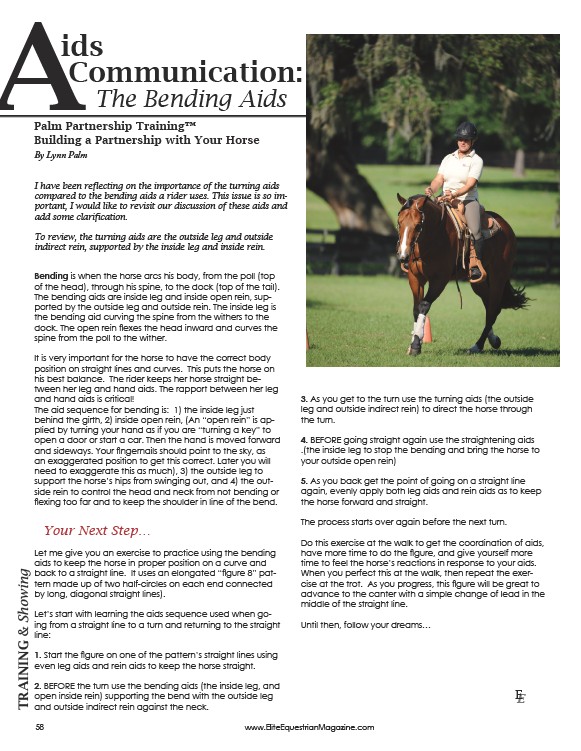
Bending is when the horse arcs his body, from the poll (top
of the head), through his spine, to the dock (top of the tail).
The bending aids are inside leg and inside open rein, supported
by the outside leg and outside rein. The inside leg is
the bending aid curving the spine from the withers to the
dock. The open rein flexes the head inward and curves the
spine from the poll to the wither.
It is very important for the horse to have the correct body
position on straight lines and curves. This puts the horse on
his best balance. The rider keeps her horse straight between
her leg and hand aids. The rapport between her leg
and hand aids is critical!
The aid sequence for bending is: 1) the inside leg just
behind the girth, 2) inside open rein, (An “open rein” is applied
by turning your hand as if you are “turning a key” to
open a door or start a car. Then the hand is moved forward
and sideways. Your fingernails should point to the sky, as
an exaggerated position to get this correct. Later you will
need to exaggerate this as much), 3) the outside leg to
support the horse’s hips from swinging out, and 4) the outside
rein to control the head and neck from not bending or
flexing too far and to keep the shoulder in line of the bend.
Let me give you an exercise to practice using the bending
aids to keep the horse in proper position on a curve and
back to a straight line. It uses an elongated “figure 8” pattern
made up of two half-circles on each end connected
by long, diagonal straight lines).
Let’s start with learning the aids sequence used when going
from a straight line to a turn and returning to the straight
line:
1. Start the figure on one of the pattern’s straight lines using
even leg aids and rein aids to keep the horse straight.
2. BEFORE the turn use the bending aids (the inside leg, and
open inside rein) supporting the bend with the outside leg
and outside indirect rein against the neck.
TRAINING & Showing
58 www.EliteEquestrianMagazine.com
EE
A
3. As you get to the turn use the turning aids (the outside
leg and outside indirect rein) to direct the horse through
the turn.
4. BEFORE going straight again use the straightening aids
.(the inside leg to stop the bending and bring the horse to
your outside open rein)
5. As you back get the point of going on a straight line
again, evenly apply both leg aids and rein aids as to keep
the horse forward and straight.
The process starts over again before the next turn.
Do this exercise at the walk to get the coordination of aids,
have more time to do the figure, and give yourself more
time to feel the horse’s reactions in response to your aids.
When you perfect this at the walk, then repeat the exercise
at the trot. As you progress, this figure will be great to
advance to the canter with a simple change of lead in the
middle of the straight line.
Until then, follow your dreams…
Your Next Step…
/www.EliteEquestrianMagazine.com