46
PARENTING WITH
WORDS & PICTURES: Jessica Schubick
The Early Learning Coalition of Manatee County (ELC)
has debuted a new research-based program this year
which helps prepare parents to succeed in their role as
their child’s ��rst and most important teacher. Play and Learning
Strategies, also known as “PALS”, is a preventive intervention
program that strengthens the bond between parent and child and
stimulates early language, cognitive, and social development.
Sharon ��ansen, PALS Program Specialist, says: “The goal of
the program is to prepare children to be successful in school –
so that means working on social-emotional, literacy, language,
and problem-solving skills – all those things that go into a child’s
success. But PALS also improves the parent-child bond.”
PALS was created by the Children’s Learning Institute in ��ouston,
Texas. The program was developed to facilitate parents' mastery
of speci��c skills for interacting with their infants and toddlers
that lead to better child outcomes, particularly in children from
families with limited resources.
Kerry Gaylord, Director of Child Development, adds: “It truly is
supporting the parent as the child’s ��rst teacher at home – which
is part of our mission at the Early Learning Coalition. It’s giving
them all the tools to be successful so that, in turn, the child is
ready for school.”
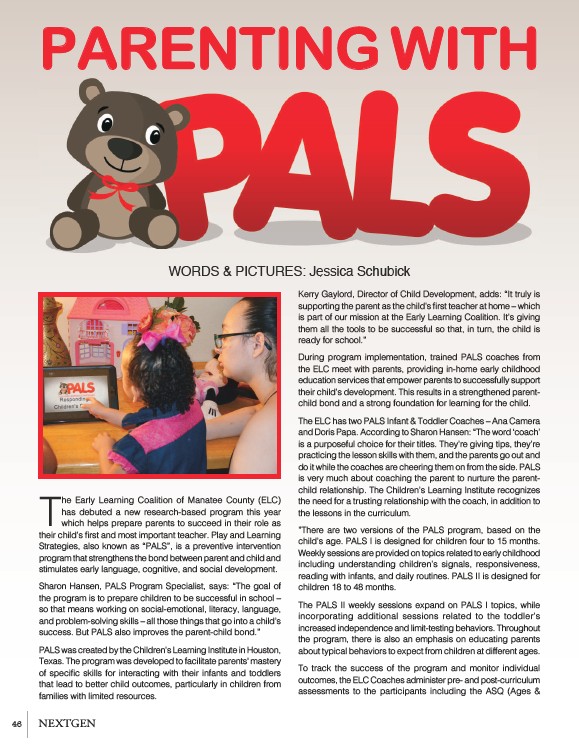
During program implementation, trained PALS coaches from
the ELC meet with parents, providing in-home early childhood
education services that empower parents to successfully support
their child’s development. This results in a strengthened parentchild
bond and a strong foundation for learning for the child.
The ELC has two PALS Infant �� Toddler Coaches – Ana Camera
and Doris Papa. According to Sharon ��ansen: “The word ‘coach’
is a purposeful choice for their titles. They’re giving tips, they’re
practicing the lesson skills with them, and the parents go out and
do it while the coaches are cheering them on from the side. PALS
is very much about coaching the parent to nurture the parentchild
relationship. The Children’s Learning Institute recognizes
the need for a trusting relationship with the coach, in addition to
the lessons in the curriculum.
”There are two versions of the PALS program, based on the
child’s age. PALS I is designed for children four to 15 months.
Weekly sessions are provided on topics related to early childhood
including understanding children’s signals, responsiveness,
reading with infants, and daily routines. PALS II is designed for
children 18 to 48 months.
The PALS II weekly sessions expand on PALS I topics, while
incorporating additional sessions related to the toddler’s
increased independence and limit-testing behaviors. Throughout
the program, there is also an emphasis on educating parents
about typical behaviors to expect from children at different ages.
To track the success of the program and monitor individual
outcomes, the ELC Coaches administer pre- and post-curriculum
assessments to the participants including the AS�� (Ages ��