GENIUS IN FIVE LETTERS / 1908
Hans Wilsdorf wanted his watches to have a name that was short, easy to say and remembered in any language
and which looked good on watch movements and dials. ROLEX was born!
THE QUEST FOR CHRONOMETRIC PRECISION / 1910
Rolex first concentrated on the quality of the movements. The relentless quest for chronometric precision rapidly
led to success. In 1910, a Rolex watch was the first wristwatch in the world to receive the Swiss Certificate of
Chronometric Precision granted by the Official Watch Rating Centre in Bienne.
THE QUEST FOR CHRONOMETRIC
PRECISION / 1914
Four years later, in 1914, New Observatory in Great
Britain awarded a Rolex wristwatch a class “A”
precision certificate, a distinction which until that point
in time had been reserved exclusively for marine
chronometers. From that date forward, the Rolex
wristwatch was synonymous with precision.
GENEVA / 1919
Rolex moved to Geneva, a city renowned
internationally for watch making. Montres Rolex S.A.
was registered in Geneva in 1920.
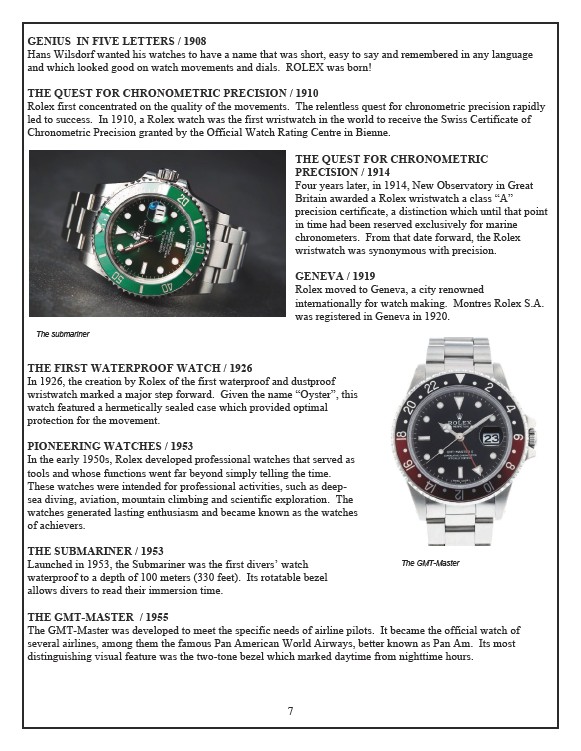
The submariner
THE FIRST WATERPROOF WATCH / 1926
In 1926, the creation by Rolex of the first waterproof and dustproof
wristwatch marked a major step forward. Given the name “Oyster”, this
watch featured a hermetically sealed case which provided optimal
protection for the movement.
PIONEERING WATCHES / 1953
In the early 1950s, Rolex developed professional watches that served as
tools and whose functions went far beyond simply telling the time.
These watches were intended for professional activities, such as deepsea
diving, aviation, mountain climbing and scientific exploration. The
watches generated lasting enthusiasm and became known as the watches
of achievers.
THE SUBMARINER / 1953
Launched in 1953, the Submariner was the first divers’ watch
waterproof to a depth of 100 meters (330 feet). Its rotatable bezel
allows divers to read their immersion time.
THE GMT-MASTER / 1955
The GMT-Master was developed to meet the specific needs of airline pilots. It became the official watch of
several airlines, among them the famous Pan American World Airways, better known as Pan Am. Its most
distinguishing visual feature was the two-tone bezel which marked daytime from nighttime hours.
7
The GMT-Master