up all that lies between him and the House. If Allah puts
nothing in his way to stop him from reaching it, then, by
Allah, we have no strength against him” (Seerah Ibn Hisham,
1/48). It was the same when Alexander the Great crossed over
the north. He also skirted the Peninsula entirely in 334 B.C.
His map of the Helenian empire shows a border that spans
lands to the east, west, and even north of the Peninsula, but
the Peninsula itself is virginal like an empty outcropping of
land surrounded by water.
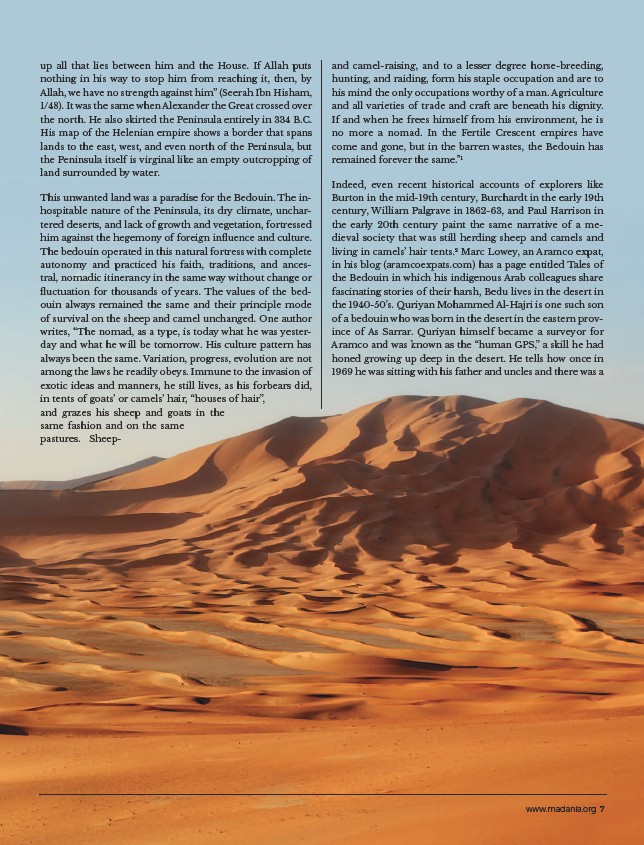
This unwanted land was a paradise for the Bedouin. The inhospitable
nature of the Peninsula, its dry climate, unchartered
deserts, and lack of growth and vegetation, fortressed
him against the hegemony of foreign influence and culture.
The bedouin operated in this natural fortress with complete
autonomy and practiced his faith, traditions, and ancestral,
nomadic itinerancy in the same way without change or
fluctuation for thousands of years. The values of the bedouin
always remained the same and their principle mode
of survival on the sheep and camel unchanged. One author
writes, “The nomad, as a type, is today what he was yesterday
and what he will be tomorrow. His culture pattern has
always been the same. Variation, progress, evolution are not
among the laws he readily obeys. Immune to the invasion of
exotic ideas and manners, he still lives, as his forbears did,
in tents of goats’ or camels’ hair, “houses of hair”,
and grazes his sheep and goats in the
same fashion and on the same
pastures. Sheep-
and camel-raising, and to a lesser degree horse-breeding,
hunting, and raiding, form his staple occupation and are to
his mind the only occupations worthy of a man. Agriculture
and all varieties of trade and craft are beneath his dignity.
If and when he frees himself from his environment, he is
no more a nomad. In the Fertile Crescent empires have
come and gone, but in the barren wastes, the Bedouin has
remained forever the same.”1
Indeed, even recent historical accounts of explorers like
Burton in the mid-19th century, Burchardt in the early 19th
century, William Palgrave in 1862-63, and Paul Harrison in
the early 20th century paint the same narrative of a medieval
society that was still herding sheep and camels and
living in camels’ hair tents.2 Marc Lowey, an Aramco expat,
in his blog (aramcoexpats.com) has a page entitled Tales of
the Bedouin in which his indigenous Arab colleagues share
fascinating stories of their harsh, Bedu lives in the desert in
the 1940-50’s. Quriyan Mohammed Al-Hajri is one such son
of a bedouin who was born in the desert in the eastern province
of As Sarrar. Quriyan himself became a surveyor for
Aramco and was known as the “human GPS,” a skill he had
honed growing up deep in the desert. He tells how once in
1969 he was sitting with his father and uncles and there was a
www.madania.org 7
/(aramcoexpats.com
/www.madania.org