of troops in a short time, which would prove helpful during
World War II.
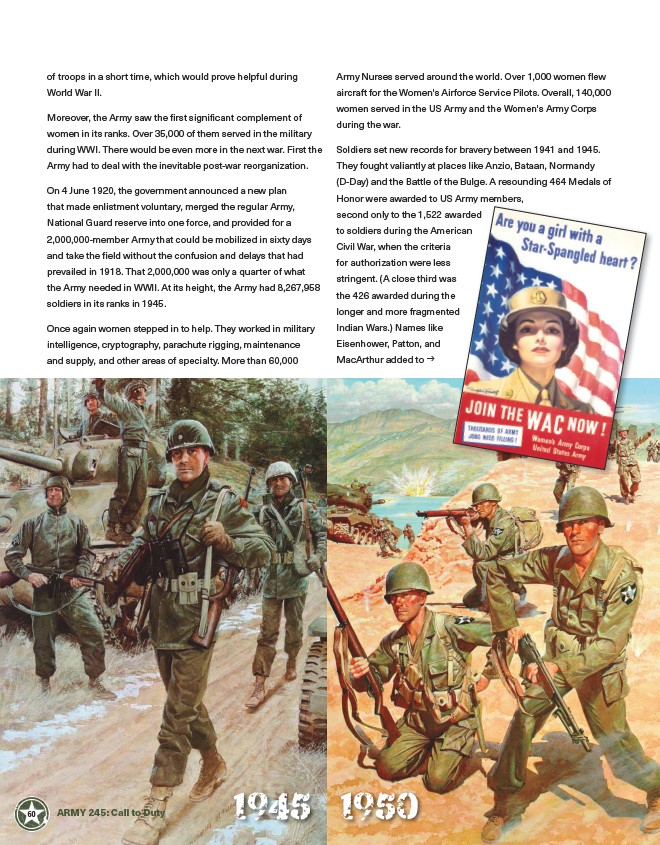
Moreover, the Army saw the first significant complement of
women in its ranks. Over 35,000 of them served in the military
during WWI. There would be even more in the next war. First the
Army had to deal with the inevitable post-war reorganization.
On 4 June 1920, the government announced a new plan
that made enlistment voluntary, merged the regular Army,
National Guard reserve into one force, and provided for a
2,000,000-member Army that could be mobilized in sixty days
and take the field without the confusion and delays that had
prevailed in 1918. That 2,000,000 was only a quarter of what
the Army needed in WWII. At its height, the Army had 8,267,958
soldiers in its ranks in 1945.
Once again women stepped in to help. They worked in military
intelligence, cryptography, parachute rigging, maintenance
and supply, and other areas of specialty. More than 60,000
Army Nurses served around the world. Over 1,000 women flew
aircraft for the Women's Airforce Service Pilots. Overall, 140,000
women served in the US Army and the Women's Army Corps
during the war.
Soldiers set new records for bravery between 1941 and 1945.
They fought valiantly at places like Anzio, Bataan, Normandy
(D-Day) and the Battle of the Bulge. A resounding 464 Medals of
Honor were awarded to US Army members,
second only to the 1,522 awarded
to soldiers during the American
Civil War, when the criteria
for authorization were less
stringent. (A close third was
the 426 awarded during the
longer and more fragmented
Indian Wars.) Names like
Eisenhower, Patton, and
MacArthur added to ������
1945 1950
warded
erican
a
s
as
e
ed
60 ARMY 245: Call to Duty