ADDITIONAL MITIGATION MEASURES
Although identifying hazards and
effective leadership are crucial, there
are additional mitigation measures
commands must consider during the
fourth quarter. Managing transitions,
especially given the current environment,
will be complicated. However, proactive
planning for transitions, seeking to
rebuild habitual relationships and
maintaining a running estimate of combat
power based on personnel turbulence
will provide senior leaders a realistic
assessment of capabilities. Furthermore,
instituting deliberate mission briefings
and rehearsals, tied with an incremental
training strategy to allow aircrews to
establish (or re-establish) proficiency in
the mission and environment, will pay
significant dividends to the force. Finally,
whether units see a significant transition
in personnel or retain their combat power,
the substantial change in the environment
will make no mission “routine.” Maximizing
unit ASOs, enforcing SOPs and having the
THANK YOU
FOR YOUR
SERVICE
AND
SACRIFICE.
GORMAN-RUPP PUMPS
P.O. Box 1217 I Mansfifield, OH 44901 I PH: 419.755.1011 I FX: 419.755.1251
Contact: Ashley Klasnich at aklasnich@gormanrupp.com
GRpumps.com
588 © 2020 The Gorman-Rupp Company.
right mitigation measures in place prior
to and during the fourth quarter will help
ensure mission success.
WINNING THE FOURTH QUARTER
The Army is a learning organization, and
having foresight of the hazards associated
with fourth-quarter operations, along with
effective leadership and controls, will
allow our formations to proactively plan
for and mitigate risks. Turbulence during
this timeframe happens every year and is
forthcoming in FY20. However, as the US
Army Combat Readiness Center (USACRC)
commander states, “Collective critical
thinking, discussion and sharing of best
practices within our communities will allow
us to reverse this trend.” One of my former
Army football coaches preached that “we
must win the fourth quarter.” How profound
that those words still apply today in Army
Aviation. Winning matters, especially in the
fourth quarter!
Article Courtesy of Colonel Jason Miller, Deputy
Commander US Army Combat Readiness Center
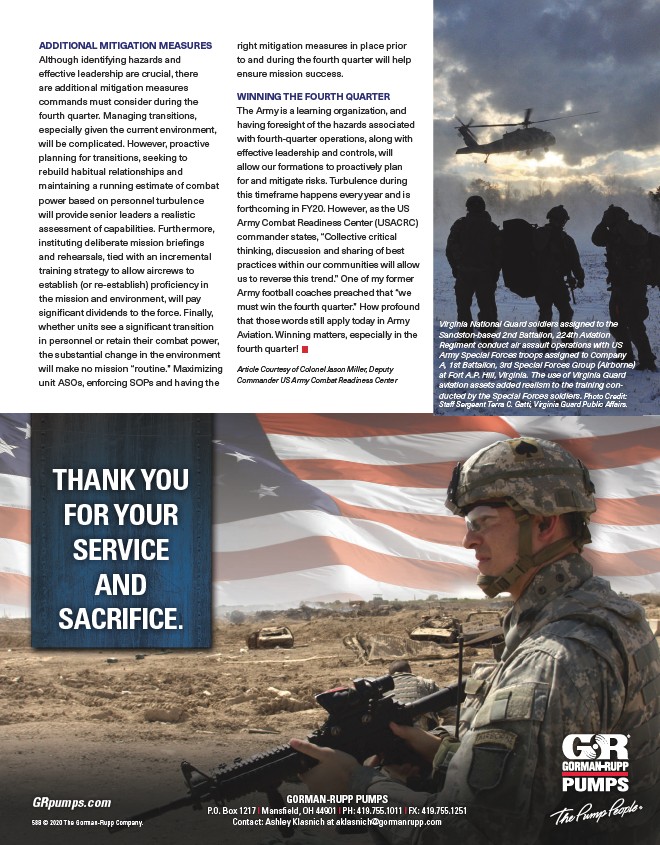
Virginia National Guard soldiers assigned to the
Sandston-based 2nd Battalion, 224th Aviation
Regiment conduct air assault operations with US
Army Special Forces troops assigned to Company
A, 1st Battalion, 3rd Special Forces Group (Airborne)
at Fort A.P. Hill, Virginia. The use of Virginia Guard
aviation assets added realism to the training conducted
by the Special Forces soldiers. Photo Credit:
Staff Sergeant Terra C. Gatti, Virginia Guard Public Affairs.
/GRpumps.com
link