Arming the Army with the
Force of Foresight through
AVIATION
Over the previous five fiscal years, Army Aviation has
experienced roughly 40 percent of its Class A mishaps
during the fourth quarter. In numbers, that’s 21 of 53 Class A
mishaps during that timeframe, nearly double the total of any other
quarter. Plotted on a bar graph, the fourth quarter looks like the
Himalayas of mishaps as compared to the remaining quarters. This
fact should immediately garner the attention of every member of the
Army Aviation team. However, arming the force with foresight of the
hazards associated with this time period and employing effective
leadership and mitigation measures can reverse this trend.
COMPLEX HAZARDS
The fourth quarter represents a complex convergence of numerous
factors that, individually or aggregated, if not mitigated create an
increased risk to operations. The key to reducing risk during this
timeframe is to ensure units adequately plan and train for associated
complexities such as high operations tempo, fluctuations in combat
power and leadership with the summer manning cycle, and a
significant change in the operational environment and weather.
Although Army Aviation historically flies the most
hours in the third quarter, the fourth is a close
second. When coupled with significant
turbulence in leadership and combat power, as well as increased
heat, dust and prolonged day/night operations, this time period is
ripe with overlapping hazards. Armed with this knowledge, it is vital
commands confirm their leaders and aircrews are cognizant of these
complexities and employ sound planning and mitigation measures
to reverse the mishap trend.
EFFECTIVE LEADERSHIP
Aviation operations – including the tough, realistic training
required to support large-scale combat operations – are inherently
dangerous. DA PAM 385-30 states, “Managing risks related to such
operations requires educated judgment, situational knowledge,
demonstrated experience and professional competence.” In
essence, effective leader knowledge, presence and engagement
leading up to and throughout the fourth quarter will reduce risk.
We must ensure we thoroughly train our leaders for the missions
they are tasked with, position the right leaders with the proper
experience and judgment at critical points throughout the depth of
the operation, and set expectations while empowering our leaders
to make appropriate risk decisions to protect the force and mission.
Doing so will ensure appropriate oversight is in place to mitigate
fourth-quarter trends.
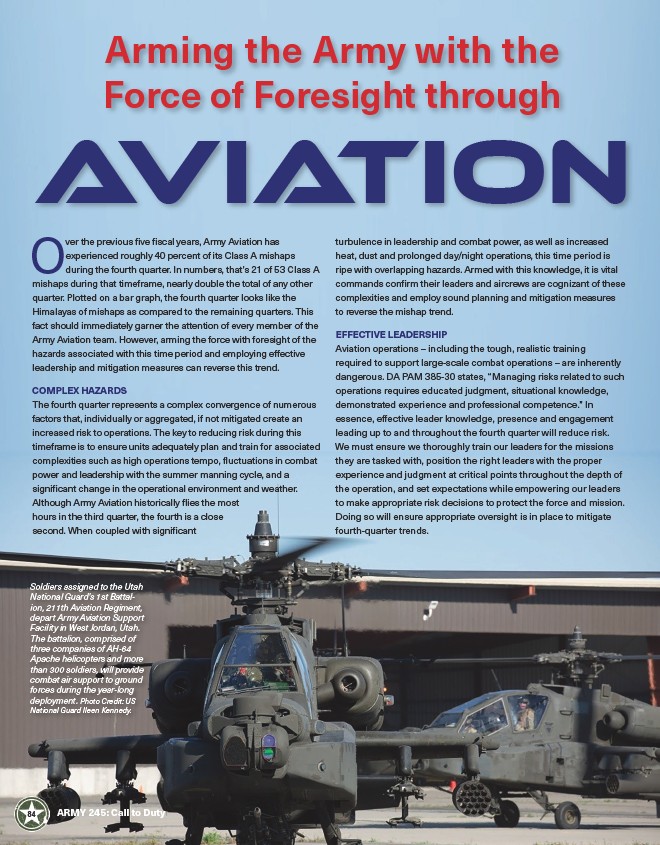
Soldiers assigned to the Utah
National Guard's 1st Battalion,
211th Aviation Regiment,
depart Army Aviation Support
Facility in West Jordan, Utah.
The battalion, comprised of
three companies of AH-64
Apache helicopters and more
than 300 soldiers, will provide
combat air support to ground
forces during the year-long
deployment. Photo Credit: US
National Guard Ileen Kennedy.
84 ARMY 245: Call to Duty