artwork were found in small curio
shops located in and near Florida’s
resort hotels.
Larry Roberts’s book published
in 2001, Florida’s Golden Age
of Souvenirs, 1890-1930 gives
collectors a fantastic look at
the origins of Florida tourism
souvenirs. The four decades
that followed, however, provided
some of the colorful,
creative and
stylistic
Florida
souvenirs.
The rise
of the
automobile
opened
Florida to everyday
travelers and
drastically changed
the Florida souvenir
industry. Traveling to
Florida was no longer
limited to the wealthy winter
visitors - the working class could
now vacation in Florida.
Tourist attractions soon sprouted
up throughout the Florida
peninsula. Motor courts lined the
highways, and so did roadside
souvenir shops. The souvenir
industry flourished, and many
manufacturers and distributors
were based in Florida. Studies
during the 1950s estimated that
10 to 15% of tourist expenditures
were for souvenirs.
Souvenir shops have been a part
of Florida’s roadside landscape
since the 1920s. As Florida’s
roadways expanded and improved,
entrepreneurs opened roadside
businesses, a key part of the
Florida’s tourism experience,
capitalizing on burgeoning
automobile tourism.
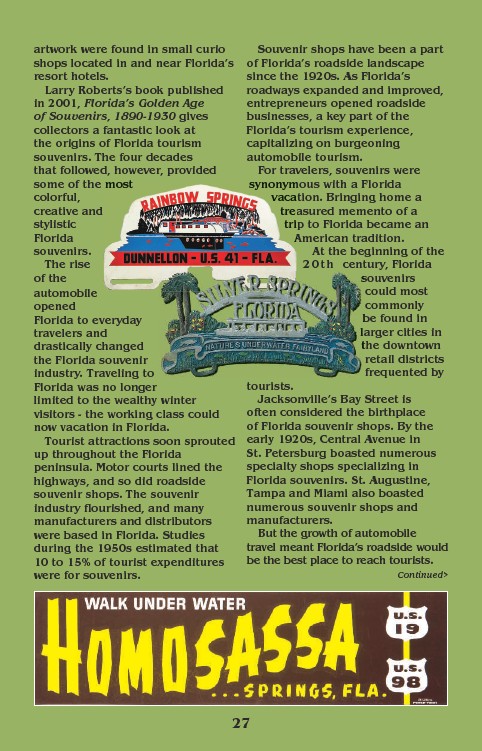
For travelers, souvenirs were
synonymous with a Florida
27
vacation. Bringing home a
treasured memento of a
trip to Florida became an
American tradition.
At the beginning of the
20t h century, Florida
souvenirs
could most
commonly
be found in
larger cities in
the downtown
retail districts
frequented by
tourists.
Jacksonville’s Bay Street is
often considered the birthplace
of Florida souvenir shops. By the
early 1920s, Central Avenue in
St. Petersburg boasted numerous
specialty shops specializing in
Florida souvenirs. St. Augustine,
Tampa and Miami also boasted
numerous souvenir shops and
manufacturers.
But the growth of automobile
travel meant Florida’s roadside would
be the best place to reach tourists.
Continued>
most
synonym
vaca
tre
tri
A
s
b
l
t