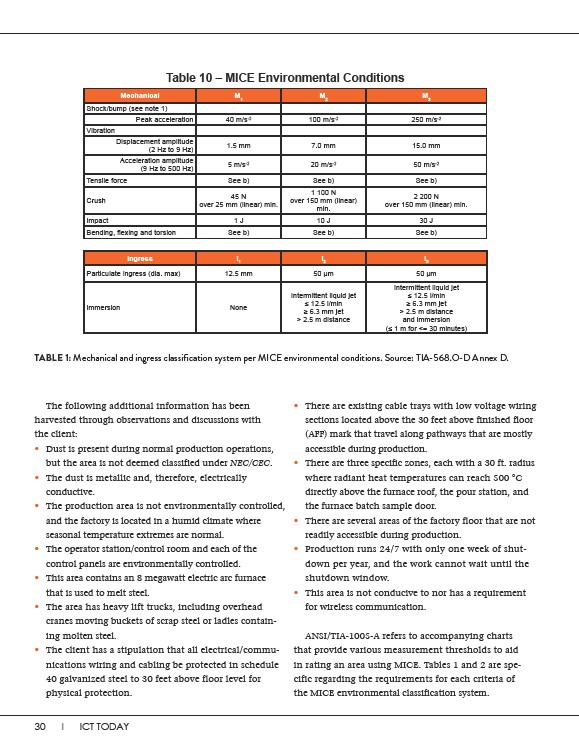
Table 10 – MICE Environmental Conditions
Mechanical M1 M2 M3
The following additional information has been
harvested through observations and discussions with
the client:
• Dust is present during normal production operations,
but the area is not deemed classified under NEC/CEC.
• The dust is metallic and, therefore, electrically
conductive.
• The production area is not environmentally controlled,
and the factory is located in a humid climate where
seasonal temperature extremes are normal.
• The operator station/control room and each of the
control panels are environmentally controlled.
• This area contains an 8 megawatt electric arc furnace
that is used to melt steel.
• The area has heavy lift trucks, including overhead
cranes moving buckets of scrap steel or ladles containing
molten steel.
• The client has a stipulation that all electrical/communications
wiring and cabling be protected in schedule
40 galvanized steel to 30 feet above floor level for
physical protection.
30 I ICT TODAY
• There are existing cable trays with low voltage wiring
sections located above the 30 feet above finished floor
(AFF) mark that travel along pathways that are mostly
accessible during production.
• There are three specific zones, each with a 30 ft. radius
where radiant heat temperatures can reach 500 °C
directly above the furnace roof, the pour station, and
the furnace batch sample door.
• There are several areas of the factory floor that are not
readily accessible during production.
• Production runs 24/7 with only one week of shutdown
per year, and the work cannot wait until the
shutdown window.
• This area is not conducive to nor has a requirement
for wireless communication.
ANSI/TIA-1005-A refers to accompanying charts
that provide various measurement thresholds to aid
in rating an area using MICE. Tables 1 and 2 are specific
regarding the requirements for each criteria of
the MICE environmental classification system.
Shock/bump (see note 1)
Peak acceleration 40 m/s-2 100 m/s-2 250 m/s-2
Vibration
Displacement amplitude
(2 Hz to 9 Hz) 1.5 mm 7.0 mm 15.0 mm
Acceleration amplitude
(9 Hz to 500 Hz) 5 m/s-2 20 m/s-2 50 m/s-2
Tensile force See b) See b) See b)
Crush 45 N
over 25 mm (linear) min.
1 100 N
over 150 mm (linear)
min.
2 200 N
over 150 mm (linear) min.
Impact 1 J 10 J 30 J
������������������������������������������������������ See b) See b) See b)
Ingress I1 I2 I3
Particulate ingress (dia. max) 12.5 mm 50 μm 50 μm
Immersion None
Intermittent liquid jet
������������������������
������������������������
> 2.5 m distance
Intermittent liquid jet
������������������������
������������������������
> 2.5 m distance
and immersion
��������������������������������������������������
TABLE 1: Mechanical and ingress classification system per MICE environmental conditions. Source: TIA-568.O-D Annex D.