EVERYTHING family
LEASH
“Mom, would you ever
consider a service dog,”
she asked. Brave, given
I’d recently announced I
would never get another
animal.
With the goal of getting
my daughter back into
school in August, our
learning curve was steep.
Along with all the medical
testing, we’d need a
psychiatric service animal,
not an emotional support
animal (ESA).
ESAs are prescribed
by a licensed mental
health professional to a
person with a psychiatric
condition. Even so, ESAs
don’t have the public
access rights that service
dogs do. While able
to fly on some airlines,
ESAs aren’t allowed
in restaurants, malls,
or schools. Thanks to
the Americans With
Disabilities Act (ADA),
a service dog is generally
allowed to go everywhere
their handler goes.
The ADA defines service
animals as “dogs or
miniature horses that
are individually trained
to do work or perform
tasks for people with
disabilities.” Emotional
support, although
beneficial, is not a task.
In our instance, the tasks
we needed was to alert my
daughter to an oncoming
seizure (by scent, up to
an hour ahead of time),
allowing her to take
preventative medication
and/or action. Other
tasks include protecting
A support duck. That’s right. Someone
������������������������������������������������������������������������������
������������������������������������������������������������������������������
heard about air passengers having
support chickens, pigs, and even a
kangaroo. And while amusing and
shocking, there is in fact a valid place
for these animals in the lives of people
facing emotional and mental health
challenges.
Last April, my teen daughter’s mental health status
became acute, causing daily nonepilectic seizures
and 9-1-1 calls from strangers — at school, stores,
restaurants, and movie theaters. Our world suddenly
shrank to our home and our car, the only places she
felt safe.
her head during seizures
and applying deep pressure
therapy during recovery.
After a whirlwind and
heartwarming Go Fund
Me campaign run by my
eldest daughter, we landed
on Kodiak Service Dogs
out of St. Augustine, Fla.,
with service dog trainer
Hanna Vickers.
“I’m a firm believer that
animals have a healing
power that is not seen
but felt,” Hanna said.
“Animals can sense things
that humans can only
dream of sensing... Hope
on a leash (or a reign) is an
understatement.”
For three months, Hanna
task trained with Annie,
a black lab from an
Oklahoma obedience
school. On the first day
of my daughter’s school,
though, she and Annie were
home by noon. Due to an
unforeseen nervousness
around men and boys,
Annie was unable to focus.
Although Annie couldn’t
provide service work, she
has found her forever home
— with us as a beloved
family pet.
And so, meet Blue, a
golden retriever puppy
chosen by Hanna who
is now in training. Blue
shows every promise
— temperament,
intelligence, strength —
of being the service dog
that my daughter deserves
and needs to return to
school next year. Blue is
our hope on a leash.
Hope on a
Anne Conroy-Baiter, president of Junior Achievement of
the Space Coast, has more than 25 years of experience
in nonprofit management, entrepreneurship, marketing,
and fundraising. Anne is inspired by the potential for JA
to spark community betterment, especially in providing
the tools for children to break the bonds of poverty and
aspire to lofty goals. Her family recently grew by a few
extra pairs of legs.
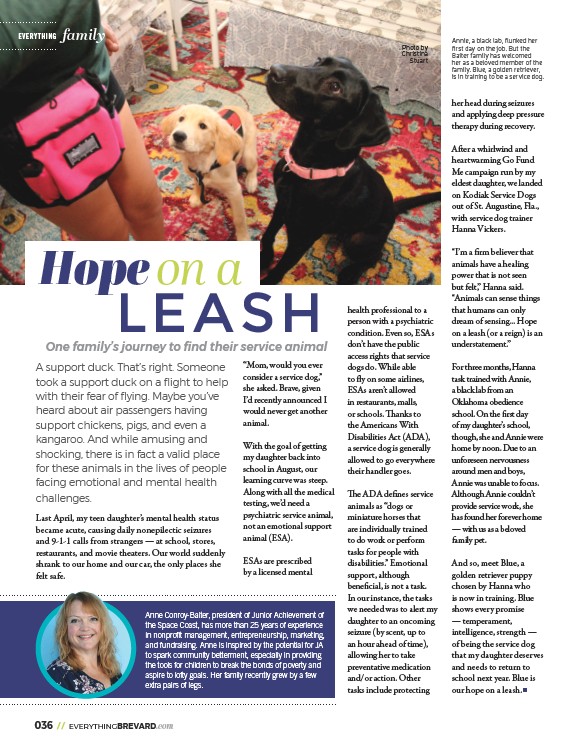
Annie, a black lab, flunked her
first day on the job. But the
Baiter family has welcomed
her as a beloved member of the
family. Blue, a golden retriever,
is in training to be a service dog.
Photo by
Christina
Stuart
������������������������������������������������������������������������������������������������
036 // EVERYTHINGBREVARD.com
/EVERYTHINGBREVARD.com