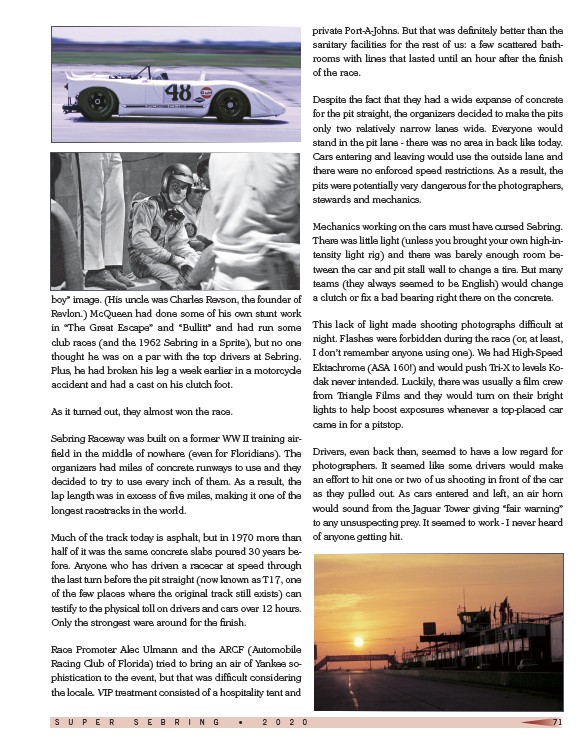
boy” image. (His uncle was Charles Revson, the founder of
Revlon.) McQueen had done some of his own stunt work
in “The Great Escape” and “Bullitt” and had run some
club races (and the 1962 Sebring in a Sprite), but no one
thought he was on a par with the top drivers at Sebring.
Plus, he had broken his leg a week earlier in a motorcycle
accident and had a cast on his clutch foot.
As it turned out, they almost won the race.
Sebring Raceway was built on a former WW II training airfield
in the middle of nowhere (even for Floridians). The
organizers had miles of concrete runways to use and they
decided to try to use every inch of them. As a result, the
lap length was in excess of five miles, making it one of the
longest racetracks in the world.
Much of the track today is asphalt, but in 1970 more than
half of it was the same concrete slabs poured 30 years before.
Anyone who has driven a racecar at speed through
the last turn before the pit straight (now known as T17, one
of the few places where the original track still exists) can
testify to the physical toll on drivers and cars over 12 hours.
Only the strongest were around for the finish.
Race Promoter Alec Ulmann and the ARCF (Automobile
Racing Club of Florida) tried to bring an air of Yankee sophistication
to the event, but that was difficult considering
the locale. VIP treatment consisted of a hospitality tent and
private Port-A-Johns. But that was definitely better than the
sanitary facilities for the rest of us: a few scattered bathrooms
with lines that lasted until an hour after the finish
of the race.
Despite the fact that they had a wide expanse of concrete
for the pit straight, the organizers decided to make the pits
only two relatively narrow lanes wide. Everyone would
stand in the pit lane - there was no area in back like today.
Cars entering and leaving would use the outside lane and
there were no enforced speed restrictions. As a result, the
pits were potentially very dangerous for the photographers,
stewards and mechanics.
Mechanics working on the cars must have cursed Sebring.
There was little light (unless you brought your own high-intensity
light rig) and there was barely enough room between
the car and pit stall wall to change a tire. But many
teams (they always seemed to be English) would change
a clutch or fix a bad bearing right there on the concrete.
This lack of light made shooting photographs difficult at
night. Flashes were forbidden during the race (or, at least,
I don’t remember anyone using one). We had High-Speed
Ektachrome (ASA 160!) and would push Tri-X to levels Kodak
never intended. Luckily, there was usually a film crew
from Triangle Films and they would turn on their bright
lights to help boost exposures whenever a top-placed car
came in for a pitstop.
Drivers, even back then, seemed to have a low regard for
photographers. It seemed like some drivers would make
an effort to hit one or two of us shooting in front of the car
as they pulled out. As cars entered and left, an air horn
would sound from the Jaguar Tower giving “fair warning”
to any unsuspecting prey. It seemed to work - I never heard
of anyone getting hit.
�� �� �� �� �� �� �� �� �� �� �� �� �� �� �� �� �� �� �� �� 71