Gestalt
continued from page 8
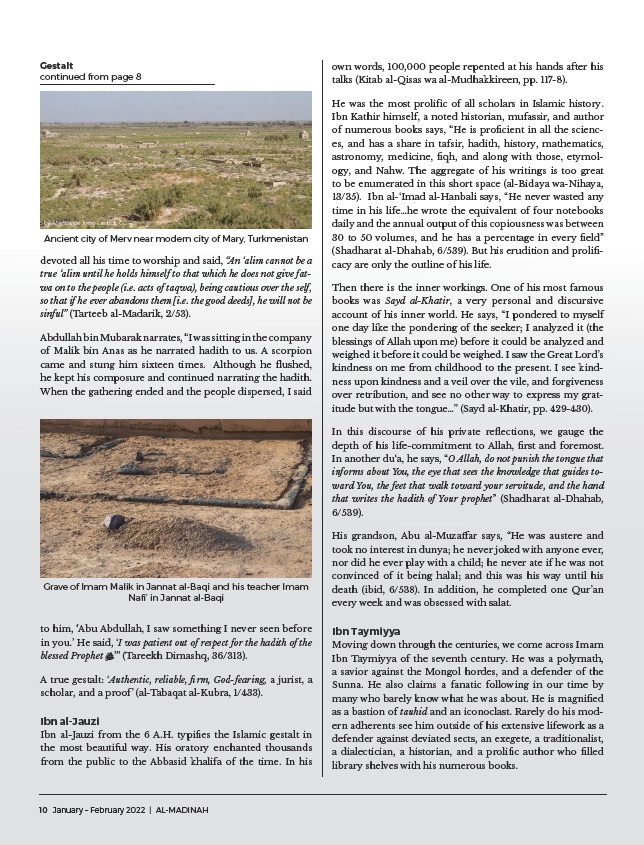
Ancient city of Merv near modern city of Mary, Turkmenistan
devoted all his time to worship and said, “An ‘alim cannot be a
true ‘alim until he holds himself to that which he does not give fatwa
on to the people (i.e. acts of taqwa), being cautious over the self,
so that if he ever abandons them i.e. the good deeds, he will not be
sinful” (Tarteeb al-Madarik, 2/53).
Abdullah bin Mubarak narrates, “I was sitting in the company
of Malik bin Anas as he narrated hadith to us. A scorpion
came and stung him sixteen times. Although he flushed,
he kept his composure and continued narrating the hadith.
When the gathering ended and the people dispersed, I said
Grave of Imam Malik in Jannat al-Baqi and his teacher Imam
Nafi’ in Jannat al-Baqi
own words, 100,000 people repented at his hands after his
talks (Kitab al-Qisas wa al-Mudhakkireen, pp. 117-8).
He was the most prolific of all scholars in Islamic history.
Ibn Kathir himself, a noted historian, mufassir, and author
of numerous books says, “He is proficient in all the sciences,
and has a share in tafsir, hadith, history, mathematics,
astronomy, medicine, fiqh, and along with those, etymology,
and Nahw. The aggregate of his writings is too great
to be enumerated in this short space (al-Bidaya wa-Nihaya,
13/35). Ibn al-‘Imad al-Hanbali says, “He never wasted any
time in his life…he wrote the equivalent of four notebooks
daily and the annual output of this copiousness was between
30 to 50 volumes, and he has a percentage in every field”
(Shadharat al-Dhahab, 6/539). But his erudition and prolificacy
are only the outline of his life.
Then there is the inner workings. One of his most famous
books was Sayd al-Khatir, a very personal and discursive
account of his inner world. He says, “I pondered to myself
one day like the pondering of the seeker; I analyzed it (the
blessings of Allah upon me) before it could be analyzed and
weighed it before it could be weighed. I saw the Great Lord’s
kindness on me from childhood to the present. I see kindness
upon kindness and a veil over the vile, and forgiveness
over retribution, and see no other way to express my gratitude
but with the tongue…” (Sayd al-Khatir, pp. 429-430).
In this discourse of his private reflections, we gauge the
depth of his life-commitment to Allah, first and foremost.
In another du‘a, he says, “O Allah, do not punish the tongue that
informs about You, the eye that sees the knowledge that guides toward
You, the feet that walk toward your servitude, and the hand
that writes the hadith of Your prophet” (Shadharat al-Dhahab,
6/539).
His grandson, Abu al-Muzaffar says, “He was austere and
took no interest in dunya; he never joked with anyone ever,
nor did he ever play with a child; he never ate if he was not
convinced of it being halal; and this was his way until his
death (ibid, 6/538). In addition, he completed one Qur’an
every week and was obsessed with salat.
Ibn Taymiyya
Moving down through the centuries, we come across Imam
Ibn Taymiyya of the seventh century. He was a polymath,
a savior against the Mongol hordes, and a defender of the
Sunna. He also claims a fanatic following in our time by
many who barely know what he was about. He is magnified
as a bastion of tauhid and an iconoclast. Rarely do his modern
adherents see him outside of his extensive lifework as a
defender against deviated sects, an exegete, a traditionalist,
a dialectician, a historian, and a prolific author who filled
library shelves with his numerous books.
to him, ‘Abu Abdullah, I saw something I never seen before
in you.’ He said, ‘I was patient out of respect for the hadith of the
blessed Prophet a’” (Tareekh Dimashq, 36/313).
A true gestalt: ‘Authentic, reliable, firm, God-fearing, a jurist, a
scholar, and a proof’ (al-Tabaqat al-Kubra, 1/433).
Ibn al-Jauzi
Ibn al-Jauzi from the 6 A.H. typifies the Islamic gestalt in
the most beautiful way. His oratory enchanted thousands
from the public to the Abbasid khalifa of the time. In his
10 January – February 2022 | AL-MADINAH