����������������������������������������������������������������������������������������
By Dr. Michael Gross
What is a concussion?
Concussions in athletes at all levels –
from professional to high school – have
been all over the news every year. Not surprisingly,
concussions are a relatively common
occurrence in sports. An estimated 1.6
to 3.8 million sports and recreation-related
concussions occur in the United States each
year.
High school athletes suffer thousands of
concussions every year. Most often concussions
occur during football, ice hockey and
soccer. Among high school athletes, concussions
are most often caused by contact with
an opponent, a teammate, the ground or a
piece of equipment or object in the playing
area. In organized high school sports, concussions
occur more often in contact sports,
with football accounting for more than 60
percent of concussions. For males, the leading
cause of high school sports concussion
is football; for females, the leading cause of
high school sports concussion is soccer.
Among children and youth, ages 5-18
years, the five leading sports or recreational
activities which account for concussions include
bicycling, football, basketball, playground
activities and soccer.
Concussions do not always involve being
“knocked out” or a loss of consciousness. A
concussion occurs whenever an athlete’s
mental status changes as a result of trauma
(usually a blow to the head). A child who
shows signs of mental confusion or is
“dinged” by a blow to the head has, by definition,
suffered a concussion. A concussion,
also known as a mild traumatic brain injury
(MTBI), is caused by a bump, blow or jolt
to either the head or the body that causes the
brain to move rapidly inside the skull. A
concussion changes how the brain normally
functions.
Concussions can have serious and longterm
health effects; therefore, even a seemingly
mild “ding” or a bump on the head can
be serious.
Signs and symptoms of concussion include
headache, nausea, fatigue, confusion
or memory problems, sleep disturbances
and/or mood changes. Symptoms are typi-
THE SPORTS DOCTOR
96 BC The Mag FALL 2018
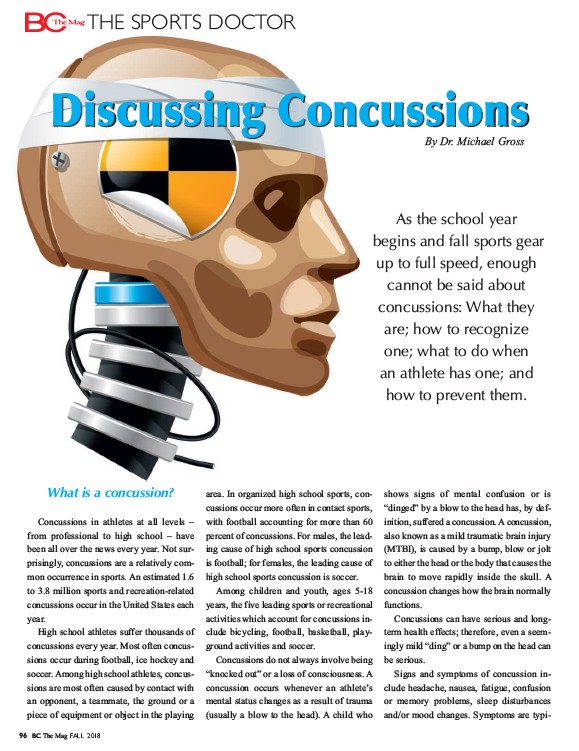
As the school year
begins and fall sports gear
up to full speed, enough
cannot be said about
concussions: What they
are; how to recognize
one; what to do when
an athlete has one; and
how to prevent them.