was targeted mostly in children with
very specific symptoms and with more
severe illness. It is likely that many more
people, both adults and children, have
been infected and had milder disease.
Who has been affected?
Dr. Slavin: Most identified infections
have been in infants, children and
teenagers. More severe infection seems
to occur in children with previously diagnosed
wheezing or asthma.
What types of illnesses do
children with EV-D68 have?
Dr. Slavin: Because this is the first
year that the virus has circulated so
broadly, the full range of disease is not
yet known. Most of the people who have
been infected have had mild respiratory
symptoms. Fever seems to be uncommon
with EV-D68. Some children have
had more severe symptoms of coughing,
shortness of breath and wheezing. Some
of these children have needed to
be cared for in the hospital. This
is more likely in children who
have other respiratory diseases,
especially children with asthma.
Is there any treatment
for EV-D68?
Dr. Slavin: There are no
antiviral drugs that treat EVD68.
Most people with mild symptoms
can be cared for safely at home. For
any significant symptoms or concerns,
medical care should be sought. Children
with asthma should have an
Asthma Action Plan; that plan needs to
be followed if any symptoms develop.
If the child does not have an action
plan, one should be developed with the
child’s physician as soon as possible.
How do I get tested
for EV-D68?
Dr. Slavin: Specific virus testing is
not usually done and is not generally
available. Since the type of
virus causing illness does
not affect treatment decisions,
testing is generally not
needed. If your doctor feels
that specific testing is needed,
then your doctor should consult
with the Department of
Health for further guidance.
How is EV-D68 spread?
Dr. Slavin: Since this is the first
year the virus has circulated broadly,
virus transmission is not as well understood.
Most likely, the virus is spread
through direct contact with infected secretions,
which can contaminate hands
and surfaces. It is also likely that EVD68
can be spread through the air from
someone who is infected and coughing
or sneezing.
How can we stop the spread?
Dr. Slavin: Hand washing with soap
and water can prevent the spread of infection.
EV-D68 is probably less susceptible
to hand sanitizers than other
viruses, although hand sanitizers may
provide some protection when soap and
water is not available. As with other respiratory
viruses, “cough etiquette” is another
way to prevent spread of infection
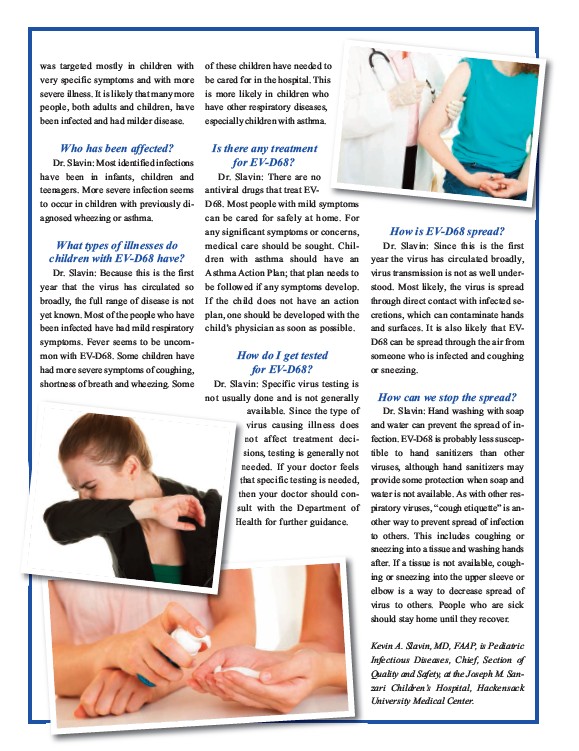
to others. This includes coughing or
sneezing into a tissue and washing hands
after. If a tissue is not available, coughing
or sneezing into the upper sleeve or
elbow is a way to decrease spread of
virus to others. People who are sick
should stay home until they recover.
Kevin A. Slavin, MD, FAAP, is Pediatric
Infectious Diseases, Chief, Section of
Quality and Safety, at the Joseph M. Sanzari
Children’s Hospital, Hackensack
University Medical Center.