Will Sanders was a critical part of
how the medical school became an
internationally known institution.
He was an incredible resource, and
he should be honored.
12 | F LO R I DA P HYS I C IAN
When Pringle was in college and
enrolled in an anatomy course at UF,
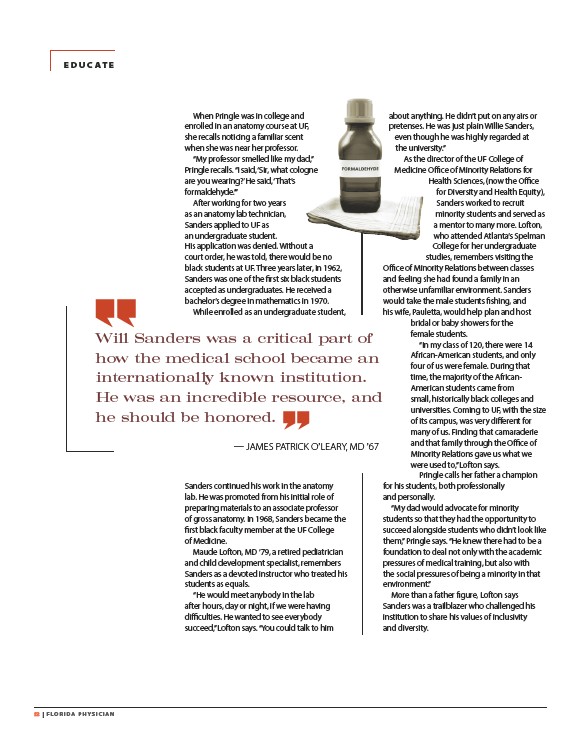
she recalls noticing a familiar scent
when she was near her professor.
“My professor smelled like my dad,”
Pringle recalls. “I said, ‘Sir, what cologne
are you wearing?’ He said, ‘That’s
formaldehyde.’”
After working for two years
as an anatomy lab technician,
Sanders applied to UF as
an undergraduate student.
His application was denied. Without a
court order, he was told, there would be no
black students at UF. Three years later, in 1962,
Sanders was one of the first six black students
accepted as undergraduates. He received a
bachelor’s degree in mathematics in 1970.
While enrolled as an undergraduate student,
Sanders continued his work in the anatomy
lab. He was promoted from his initial role of
preparing materials to an associate professor
of gross anatomy. In 1968, Sanders became the
first black faculty member at the UF College
of Medicine.
Maude Lofton, MD ’79, a retired pediatrician
and child development specialist, remembers
Sanders as a devoted instructor who treated his
students as equals.
“He would meet anybody in the lab
after hours, day or night, if we were having
difficulties. He wanted to see everybody
succeed,” Lofton says. “You could talk to him
about anything. He didn’t put on any airs or
pretenses. He was just plain Willie Sanders,
even though he was highly regarded at
the university.”
As the director of the UF College of
Medicine Office of Minority Relations for
Health Sciences, (now the Office
for Diversity and Health Equity),
Sanders worked to recruit
minority students and served as
a mentor to many more. Lofton,
who attended Atlanta’s Spelman
College for her undergraduate
studies, remembers visiting the
Office of Minority Relations between classes
and feeling she had found a family in an
otherwise unfamiliar environment. Sanders
would take the male students fishing, and
his wife, Pauletta, would help plan and host
bridal or baby showers for the
female students.
“In my class of 120, there were 14
African-American students, and only
four of us were female. During that
time, the majority of the African-
American students came from
small, historically black colleges and
universities. Coming to UF, with the size
of its campus, was very different for
many of us. Finding that camaraderie
and that family through the Office of
Minority Relations gave us what we
were used to,” Lofton says.
Pringle calls her father a champion
for his students, both professionally
and personally.
“My dad would advocate for minority
students so that they had the opportunity to
succeed alongside students who didn’t look like
them,” Pringle says. “He knew there had to be a
foundation to deal not only with the academic
pressures of medical training, but also with
the social pressures of being a minority in that
environment.”
More than a father figure, Lofton says
Sanders was a trailblazer who challenged his
institution to share his values of inclusivity
and diversity.
JAMES PATRICK O’LEARY, MD ’67
EDUCATE