Make Native Plants Your New Norm
You can start by reducing lawn areas and replacing them with
eco-friendly options like Turkey-tangle Fogfruit, Phyla nodiflora.
The Villages is a mostly upscale, modern development of managed
www.FloridaNativeNurseries.org | www.NativePlantShow.com | 5
golf course communities housing over 125,000 people in
Sumter, Marion and Lake Counties, Florida. Common areas and private
landscapes follow strictly enforced formal landscaping standards,
featuring lawns and manicured shrubs, and what residents
refer to as a “neat and tidy” appearance. Unfortunately, the impact
of non-native plant choices and traditional landscaping practices is
evident in dramatically increased water consumption, a significant
threat in a region of sinkholes and springs.
Enter The Villages Chapter Florida Native Plant Society, which
aims to make The Villages renowned for its extensive use of native
plants and award-winning native plant landscapes. The chapter has
partnered with the University of Florida IFAS to develop standard
landscape plans and provides regular education on strategies for
using native plants to reduce fertilizer, pesticide and water use. Several
homeowners have swapped turfgrass for Turkey-tangle Fogfruit,
Phyla nodiflora, a perennial
creeping, flowering native
groundcover that needs much
less water than turfgrass.
Monthly water bills have decreased
50% or more.
More examples: thevillages.fnpschapters.org
GO NATIVE!
Fogfruit as groundcover: Fogfruit, also known as Creeping Charlie, reaches
a height of 3-4" in flower. A nectar plant for many pollinating insects, it is a
larval host plant for the Common Buckeye, Phaon Crescent and White Peacock
butterflies. Blooms summer through fall in Central and North Florida
and year-round in South Florida. Needs full sun and moist soil but tolerates
short periods of drought. This plant spreads, so use it as a monoculture,
not mixed with other wildflowers. Photo: Spence Guerin
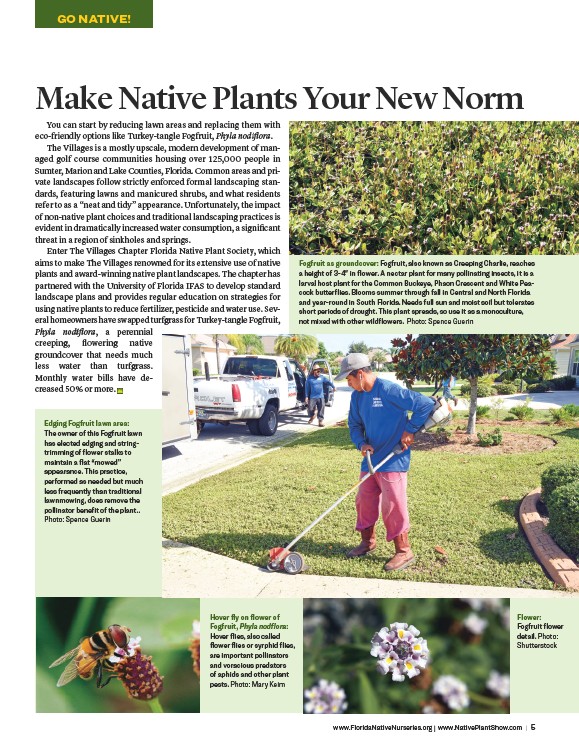
Edging Fogfruit lawn area:
The owner of this Fogfruit lawn
has elected edging and stringtrimming
of flower stalks to
maintain a flat “mowed”
appearance. This practice,
performed as needed but much
less frequently than traditional
lawnmowing, does remove the
pollinator benefit of the plant..
Photo: Spence Guerin
Hover fly on flower of
Fogfruit, Phyla nodflora:
Hover flies, also called
flower flies or syrphid flies,
are important pollinators
and voracious predators
of aphids and other plant
pests. Photo: Mary Keim
Flower:
Fogfruit flower
detail. Photo:
Shutterstock
/www.FloridaNativeNurseries.org
/www.NativePlantShow.com