October/November/December 2020 I 31
connectivity are critical for delivering reliability and
uptime. This is another area where the environment can
impact choice. If systems are being installed in a harsh
environment or one where electromagnetic interference
is present, then rugged jackets or shielding may be needed
on the cabling and connectivity components.
USE CASES AND
COMMON ENVIRONMENTS
Each data center application and environment has unique
characteristics that demand solutions that address those
characteristics, and edge deployments are no exception.
The infrastructure for a highly protected indoor environment
is vastly different than what is needed in a harsh
space. Following are common use cases where edge
is deployed, along with general information on what
has been defined as the four environments for edge:
Use Cases
Edge Colocation
The colocation market has been growing for decades. For
the most part, growth has been driven by colocation
facilities located in or near larger Tier 1 cities (e.g., New
York, San Francisco, Chicago). Applications that were
running in these facilities were not particularly latency
sensitive, and thus the distance of the colocation facility
from a company’s office was of little concern. The edge
computing trend is changing that view. Some applications
are becoming more sensitive to latency; thus, the
closer a facility is located to the end user, the better
the performance of that application. Edge colocation
is taking advantage of the trend to move colocation
facilities into more Tier 2 and Tier 3 cities. While not
compromising latency sensitivity in the process, this
is allowing companies with operations in more rural
locations to gain the benefits of colocation.
Health Care
Patient-generated health data (PGHD) is an excellent
healthcare use case. In a perfect world, data generated
by IoT technologies, such as wearables, blood glucose
monitors, home scales, telehealth tools, mHealth apps,
and other sensor-related devices, could be collected and
analyzed to pattern one’s health, allowing for detailed
preventative healthcare and event detection. Patient
data could be analyzed at a macro level to detect
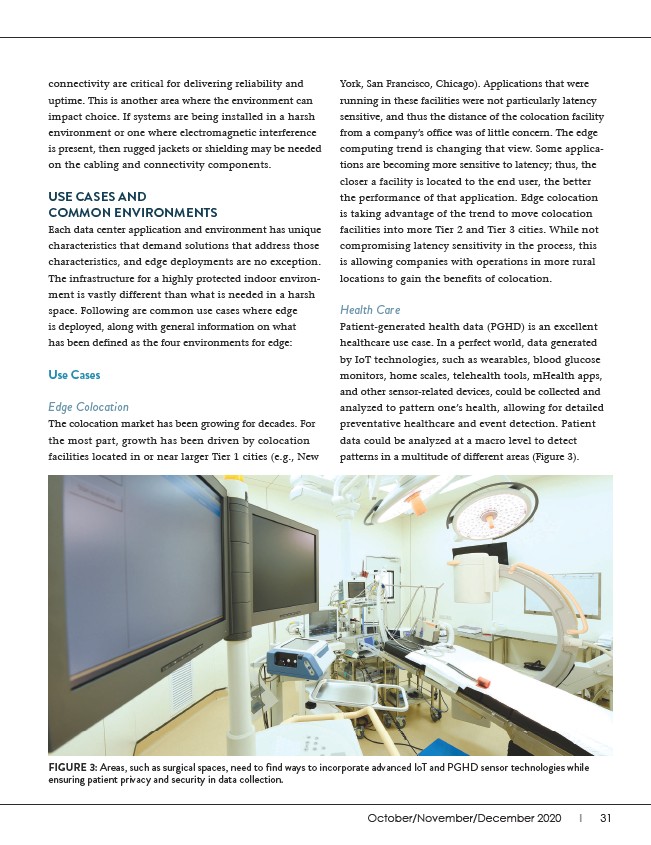
patterns in a multitude of different areas (Figure 3).
FIGURE 3: Areas, such as surgical spaces, need to find ways to incorporate advanced IoT and PGHD sensor technologies while
ensuring patient privacy and security in data collection.