Telecommunications service providers have different initiatives
for transforming their central offices to data centers. They are still
in the early stages, but the market potential is significant.
The study group found there was considerable
support for two different 400 Gb/s solutions.22
1. 400 Gb/s over 4 MMF pairs up to at least
100 m, supported by an industry expert
affiliated with one of the largest Chinese
hyperscale cloud companies
2. 400 Gb/s over 8 pairs of MMF, supported by
an industry expert affiliated with one of the
largest U.S. hyperscale cloud companies
In May 2018, the 400GBASE-SR8 baseline was
adopted; two months later, the same group adopted the
400GBASE-SR4.2 baseline.23 Later, IEEE 802.3cm was
approved in January 2020.
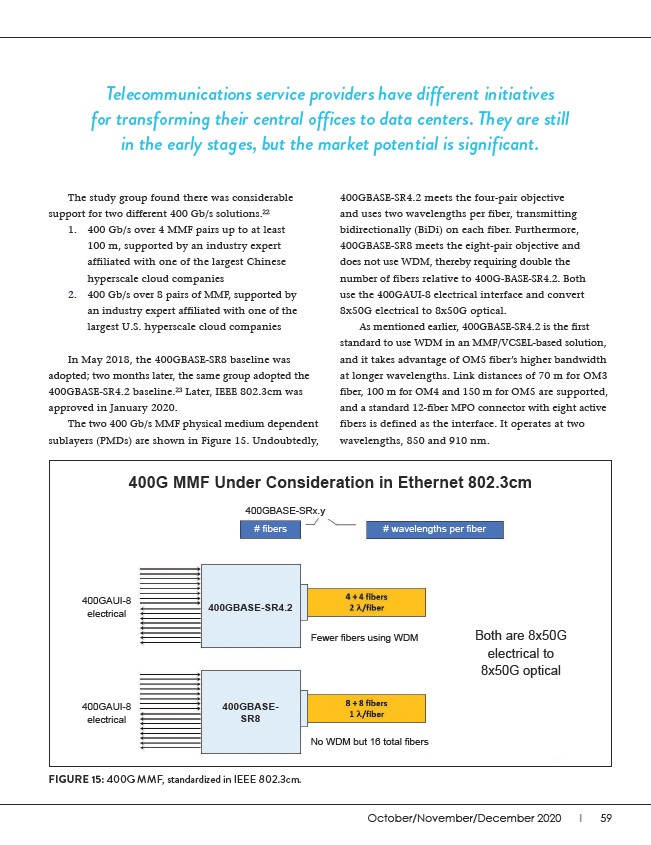
The two 400 Gb/s MMF physical medium dependent
sublayers (PMDs) are shown in Figure 15. Undoubtedly,
400G MMF Under Consideration in Ethernet 802.3cm
400GBASE-SRx.y
# fibers # wavelengths per fiber
Both are 8x50G
electrical to
8x50G optical
October/November/December 2020 I 59
400GAUI-8
electrical
Fewer fibers using WDM
No WDM but 16 total fibers
400GBASE-SR4.2
400GBASE-
SR8
400GAUI-8
electrical
FIGURE 15: 400G MMF, standardized in IEEE 802.3cm.
400GBASE-SR4.2 meets the four-pair objective
and uses two wavelengths per fiber, transmitting
bidirectionally (BiDi) on each fiber. Furthermore,
400GBASE-SR8 meets the eight-pair objective and
does not use WDM, thereby requiring double the
number of fibers relative to 400G-BASE-SR4.2. Both
use the 400GAUI-8 electrical interface and convert
8x50G electrical to 8x50G optical.
As mentioned earlier, 400GBASE-SR4.2 is the first
standard to use WDM in an MMF/VCSEL-based solution,
and it takes advantage of OM5 fiber’s higher bandwidth
at longer wavelengths. Link distances of 70 m for OM3
fiber, 100 m for OM4 and 150 m for OM5 are supported,
and a standard 12-fiber MPO connector with eight active
fibers is defined as the interface. It operates at two
wavelengths, 850 and 910 nm.