the butterfl ies can’t pump their wings right.”
OE affects the majority of the butterfl ies,
but those who raise them must also look
for signs of other diseases … including one
which Katrina claimed put her hobby in dire
jeopardy. Nuclear Polyhedrosis Virus, or the
Black Death, affects monarchs, often in the
caterpillar or chrysalis stage. The caterpillar
or chrysalis will turn black and liquefy. Katrina
felt it was hard to keep her monarchs from
getting ill and couldn’t bear to watch any
longer.
Butterfl ies are also threatened by the
tachinid fl y, which may lay
eggs and burrow under the
caterpillars’ skin. In a disturbing
fashion, maggots will kill the
creature slowly from the inside.
“You will see a strand come
out and the maggots will crawl
down it. That’s why my friends
had warned me about leaving
the eggs outside,” said Katrina.
Wasps have a similar effect on
the butterfl ies. Katrina avoids
using man made bug sprays and addressed
pesticide concerns.
“First, don’t trust your supplier,” Katrina
said, warning that many popular companies
are not aware of how their milkweed
suppliers are growing their plants. She looks
for caterpillars growing at different stages on
a plant before she buys it, and often will test
one milkweed with one caterpillar before she
exposes the rest, to be sure the new plant is
safe. This is a good sign that the milkweed
is safe for them to feed off of. She buys her
caterpillar food locally at MRT Lawn and
Garden Center.
Many of the problems that affect the
butterfl y population are in nature’s hands,
but there are some things we can control.
While the sound of mosquito trucks and
helicopters can be music to our ears as
humans, they can be a death sentence for
68 GASPARILLA MAGAZINE • November/December• 2020
our winged friends.
A recent news report addressed a recent
drop in the monarch population, which was
referred to as a “monarch massacre.” The
article refl ected on groups of dead monarchs
that littered the streets in Southwest Fargo,
North Dakota, the morning after aerial
mosquito spraying. The article highlights the
devastation to the monarch population, the
cost for mosquito control, with hundreds
monarchs reported to be lifeless.
“Mosquito spray affects the butterfl ies
and dragonfl ies. Neem oil, pesticides and
growth hormones fall into the
same category,” said Katrina.
To maintain a butterfl y-safe
environment, Katrina would skip
the bug spray and risk the prods
of a hundred mosquito needles.
Now that her quarantine
hobby is in the past, Katrina
refl ected on what made each
butterfl y species stand out to
her. “The monarchs surprisingly
had a lot more personality. The
gold rim butterfl ies were funny because
when they are caterpillars they feel like the
Pillsbury Doughboy. When you would go
to disturb them, they’d bring out these little
horns and give you a certain look,” she said.
“I had a lot of zebra longwing butterfl ies in
my yard too, which tend to be very territorial,
along with the monarchs.”
Katrina smiles when she looks back at the
time she spent picking eggs off the leaves
of her milkweed. If it weren’t for the Black
Death, she’d do it all again.
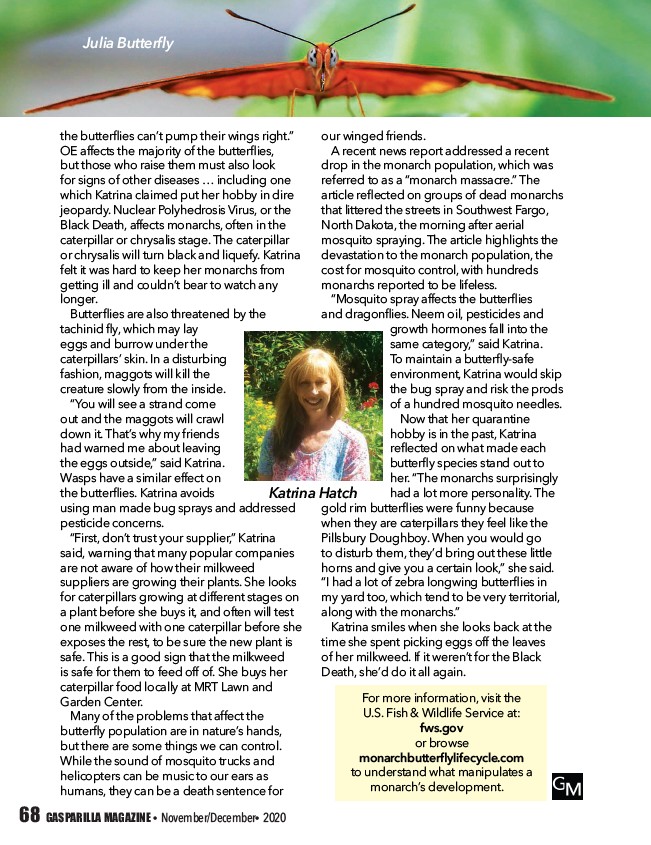
Julia Butterfl y
Katrina Hatch
For more information, visit the
U.S. Fish & Wildlife Service at:
fws.gov
or browse
monarchbutterfl ylifecycle.com
to understand what manipulates a
monarch’s development.
/fws.gov
/ylifecycle.com