TEE TIME continued
TEE TIME con't. next column TEE TIME con't. next column
TEE TIME continued
Eric Alpenfels
Director of Golf Instruction /
Golf Academy / the Pinehurst Resort
Tee Time
A Golf Lesson from the Greens
Conquering Situational
Shots on the Course, Part II
by Eric Alpenfels
In my opinion, one of the most energizing
aspects of playing golf is that no round or shot
predicament is the same as another. As a result,
the ability to adapt to different environments
and situations is a key ingredient to success
in scoring as well as to securing satisfaction
in knowing that a solid shot was hit from a
tough situation. The goal of this second in a
four-article series is to highlight the unique
conditions of soft or wet ground and how a
slight adjustment in the set up can easily make
the result more predictable and effective. In
addition, suggestions on how to practice the
shot will be offered.
First, always remember that whenever
you are faced with a challenging lie, whether
it is thick grass, hard or soft ground or even
wet ground, it is important to that you pay
attention to your hand position on the grip,
the position of the ball in your stance, and
your weight distribution at address. Once you
have these factors adjusted for the specific
lie, practice swings are effective as a way to
develop the feel of how the situation will
affect where the club makes contact with the
ground as well as your balance. The resulting
ball flight will be predictable and based on
the club choice, amount of swing taken and
the specific lie encountered. Positive results
and confidence will come from practice and
experience.
Soft and Wet Ground
When faced with a lie where the ball is on
soft or wet ground, the first step is to position
the ball slightly back (two inches) in the stance.
Next, choke down on the club approximately
one inch. Both the combination of placing the
ball back in the stance and choking down on
the club will help to create a slightly steeper
angle of approach to the ball, helping ensure
the ball is hit prior to the ground. As with all
of these types of shots, the key is that contact
be made with the ball prior to the ground.
This can be accomplished by intentionally
attempting to hit the ground slightly ahead of
the ball or by making sure to have a full finish
and avoid any fall back after impact.
The most efficient full swing clubs from
this type of lie tend to be irons and hybrids.
Practice will determine if you are able to utilize
fairway woods. This same set up is suggested
for short shots around the green with the
addition of making sure to turn through to a
full finish. In both situations, the ball will tend
to fly lower than normal and tend to have a
greater amount of roll which might dictate the
use of higher lofted clubs to compensate for
the lower trajectory when hitting short shots.
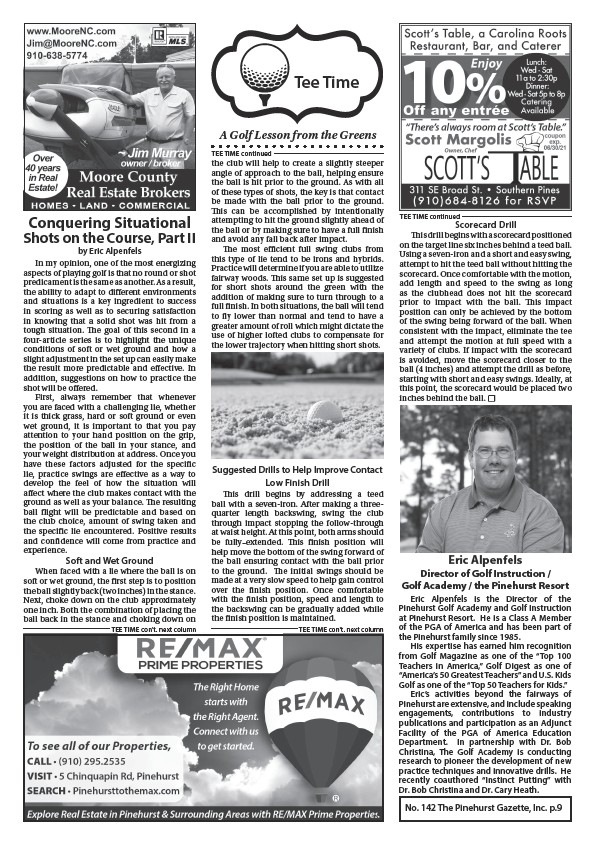
Suggested Drills to Help Improve Contact
Low Finish Drill
This drill begins by addressing a teed
ball with a seven-iron. After making a threequarter
length backswing, swing the club
through impact stopping the follow-through
at waist height. At this point, both arms should
be fully–extended. This finish position will
help move the bottom of the swing forward of
the ball ensuring contact with the ball prior
to the ground. The initial swings should be
made at a very slow speed to help gain control
over the finish position. Once comfortable
with the finish position, speed and length to
the backswing can be gradually added while
the finish position is maintained.
Scorecard Drill
This drill begins with a scorecard positioned
on the target line six inches behind a teed ball.
Using a seven-iron and a short and easy swing,
attempt to hit the teed ball without hitting the
scorecard. Once comfortable with the motion,
add length and speed to the swing as long
as the clubhead does not hit the scorecard
prior to impact with the ball. This impact
position can only be achieved by the bottom
of the swing being forward of the ball. When
consistent with the impact, eliminate the tee
and attempt the motion at full speed with a
variety of clubs. If impact with the scorecard
is avoided, move the scorecard closer to the
ball (4 inches) and attempt the drill as before,
starting with short and easy swings. Ideally, at
this point, the scorecard would be placed two
inches behind the ball. ☐
Eric Alpenfels is the Director of the
Pinehurst Golf Academy and Golf Instruction
at Pinehurst Resort. He is a Class A Member
of the PGA of America and has been part of
the Pinehurst family since 1985.
His expertise has earned him recognition
from Golf Magazine as one of the “Top 100
Teachers in America,” Golf Digest as one of
“America’s 50 Greatest Teachers” and U.S. Kids
Golf as one of the “Top 50 Teachers for Kids.”
Eric’s activities beyond the fairways of
Pinehurst are extensive, and include speaking
engagements, contributions to industry
publications and participation as an Adjunct
Facility of the PGA of America Education
Department. In partnership with Dr. Bob
Christina, The Golf Academy is conducting
research to pioneer the development of new
practice techniques and innovative drills. He
recently coauthored “Instinct Putting” with
Dr. Bob Christina and Dr. Cary Heath.
No. 142 The Pinehurst Gazette, Inc. p.9