THE PILLARS
OF ISLAM
by Abdul Rahman Irshad
In a famous hadith of Bukhari, Ibn ‘Umar k relates that the Prophet a
said, “Islam is based on five pillars:
1. Bearing witness that there is none worthy of worship except
Allah, and that Muhammad a is the messenger of Allah
2. Establishing Salah
3. Giving zakat
4. Performing hajj
5. Fasting in the month of Ramadan.”
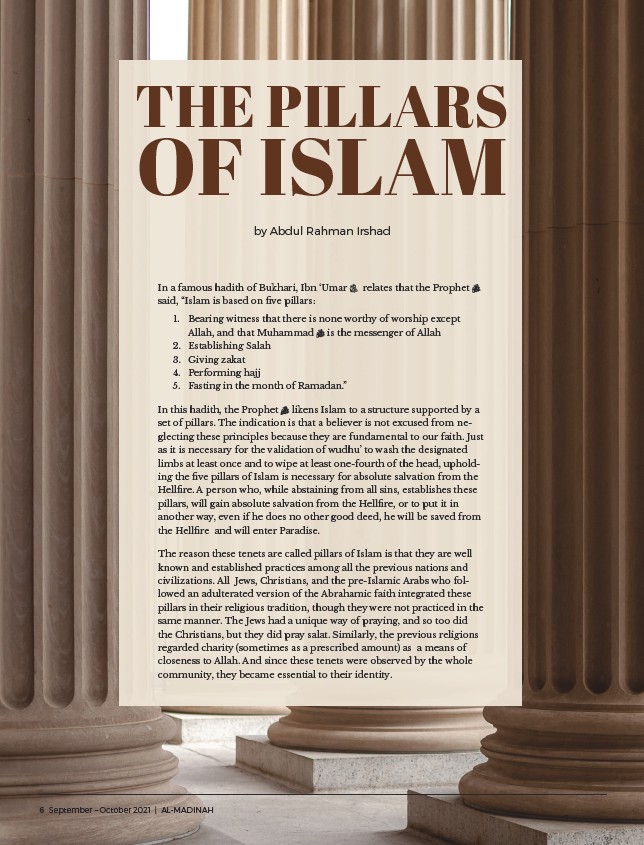
In this hadith, the Prophet a likens Islam to a structure supported by a
set of pillars. The indication is that a believer is not excused from neglecting
these principles because they are fundamental to our faith. Just
as it is necessary for the validation of wudhu’ to wash the designated
limbs at least once and to wipe at least one-fourth of the head, upholding
the five pillars of Islam is necessary for absolute salvation from the
Hellfire. A person who, while abstaining from all sins, establishes these
pillars, will gain absolute salvation from the Hellfire, or to put it in
another way, even if he does no other good deed, he will be saved from
the Hellfire and will enter Paradise.
The reason these tenets are called pillars of Islam is that they are well
known and established practices among all the previous nations and
civilizations. All Jews, Christians, and the pre-Islamic Arabs who followed
an adulterated version of the Abrahamic faith integrated these
pillars in their religious tradition, though they were not practiced in the
same manner. The Jews had a unique way of praying, and so too did
the Christians, but they did pray salat. Similarly, the previous religions
regarded charity (sometimes as a prescribed amount) as a means of
closeness to Allah. And since these tenets were observed by the whole
community, they became essential to their identity.
6 September – October 2021 | AL-MADINAH