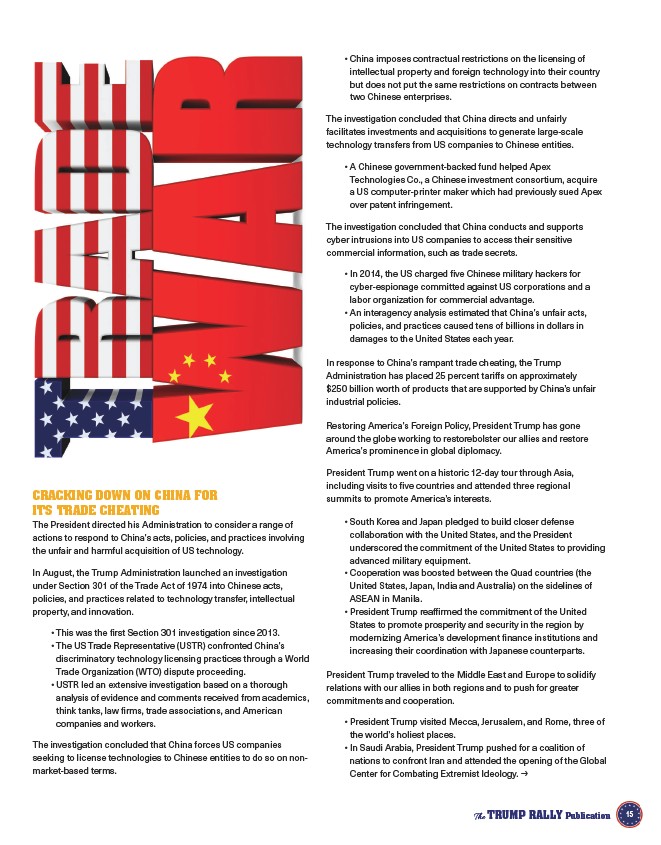
CRACKING DOWN ON CHINA FOR
ITS TRADE CHEATING
The President directed his Administration to consider a range of
actions to respond to China’s acts, policies, and practices involving
the unfair and harmful acquisition of US technology.
In August, the Trump Administration launched an investigation
under Section 301 of the Trade Act of 1974 into Chinese acts,
policies, and practices related to technology transfer, intellectual
property, and innovation.
• This was the first Section 301 investigation since 2013.
• The US Trade Representative (USTR) confronted China’s
discriminatory technology licensing practices through a World
Trade Organization (WTO) dispute proceeding.
• USTR led an extensive investigation based on a thorough
analysis of evidence and comments received from academics,
think tanks, law firms, trade associations, and American
companies and workers.
The investigation concluded that China forces US companies
seeking to license technologies to Chinese entities to do so on nonmarket
based terms.
• China imposes contractual restrictions on the licensing of
intellectual property and foreign technology into their country
but does not put the same restrictions on contracts between
two Chinese enterprises.
The investigation concluded that China directs and unfairly
facilitates investments and acquisitions to generate large-scale
technology transfers from US companies to Chinese entities.
• A Chinese government-backed fund helped Apex
Technologies Co., a Chinese investment consortium, acquire
a US computer-printer maker which had previously sued Apex
over patent infringement.
The investigation concluded that China conducts and supports
cyber intrusions into US companies to access their sensitive
commercial information, such as trade secrets.
• In 2014, the US charged five Chinese military hackers for
cyber-espionage committed against US corporations and a
labor organization for commercial advantage.
• An interagency analysis estimated that China’s unfair acts,
policies, and practices caused tens of billions in dollars in
damages to the United States each year.
In response to China’s rampant trade cheating, the Trump
Administration has placed 25 percent tariffs on approximately
$250 billion worth of products that are supported by China’s unfair
industrial policies.
Restoring America’s Foreign Policy, President Trump has gone
around the globe working to restorebolster our allies and restore
America’s prominence in global diplomacy.
President Trump went on a historic 12-day tour through Asia,
including visits to five countries and attended three regional
summits to promote America’s interests.
• South Korea and Japan pledged to build closer defense
collaboration with the United States, and the President
underscored the commitment of the United States to providing
advanced military equipment.
• Cooperation was boosted between the Quad countries (the
United States, Japan, India and Australia) on the sidelines of
ASEAN in Manila.
• President Trump reaffirmed the commitment of the United
States to promote prosperity and security in the region by
modernizing America’s development finance institutions and
increasing their coordination with Japanese counterparts.
President Trump traveled to the Middle East and Europe to solidify
relations with our allies in both regions and to push for greater
commitments and cooperation.
• President Trump visited Mecca, Jerusalem, and Rome, three of
the world’s holiest places.
• In Saudi Arabia, President Trump pushed for a coalition of
nations to confront Iran and attended the opening of the Global
Center for Combating Extremist Ideology. ��
The TRUMP RALLY Publication 15