In some hidden corners of the Internet, people can
buy access to blocks of 50,000 computers and devices
very inexpensively, drop the malicious payload and be
on their merry way. This is not science fiction. This
is real life. How do some of those transactions take
place? Through cryptocurrencies, such as bitcoin.
MANAGEABILITY
Today’s developers are used to deploying software
in large public clouds with well-formed application
programming interfaces (APIs) that are crafted by
tens of thousands of engineers. AWS (Amazon’s
web services division) employs something north
of 20,000 engineers and they manage 56 physical
locations. Compare that to the fact that there are
approximately 1,500 offshore oil rigs around the
world today or compare that to the Commercial
Buildings Energy Consumption Survey (CBECS)
estimate that there are 5.6 million commercial
buildings in the U.S. It needs to be realized that
in the future every single one of those buildings
34 I ICT TODAY
will house its own data center-like environment.
That is the edge. It not just dwarfs the public cloud,
it completely eclipses it.
Oil rigs are relying on spotty communication choices
like 3G, 4G, or Very Small Aperture Terminal (VSAT),
and each rig is producing terabytes of data, so it is no
wonder people are trying to run their compute on these
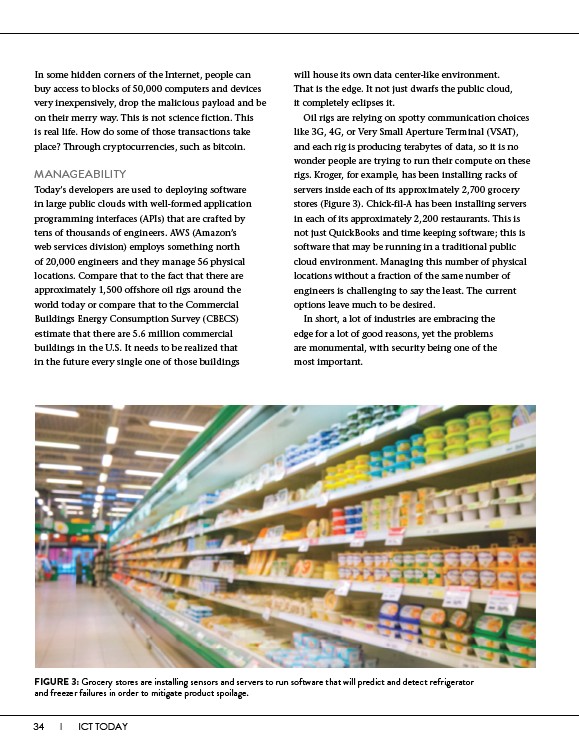
rigs. Kroger, for example, has been installing racks of
servers inside each of its approximately 2,700 grocery
stores (Figure 3). Chick-fil-A has been installing servers
in each of its approximately 2,200 restaurants. This is
not just QuickBooks and time keeping software; this is
software that may be running in a traditional public
cloud environment. Managing this number of physical
locations without a fraction of the same number of
engineers is challenging to say the least. The current
options leave much to be desired.
In short, a lot of industries are embracing the
edge for a lot of good reasons, yet the problems
are monumental, with security being one of the
most important.
FIGURE 3: Grocery stores are installing sensors and servers to run software that will predict and detect refrigerator
and freezer failures in order to mitigate product spoilage.