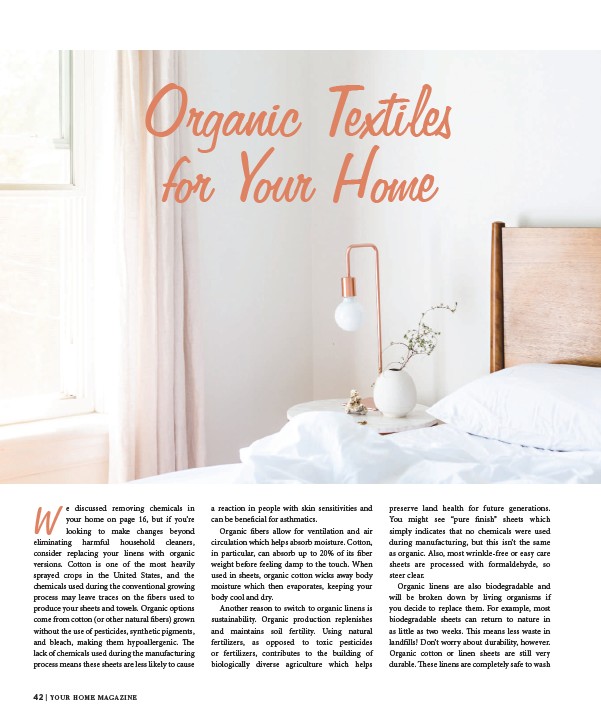
Organic Textiles
for Your Home
We discussed removing chemicals in
your home on page 16, but if you’re
looking to make changes beyond
eliminating harmful household cleaners,
consider replacing your linens with organic
versions. Cotton is one of the most heavily
sprayed crops in the United States, and the
chemicals used during the conventional growing
process may leave traces on the fibers used to
produce your sheets and towels. Organic options
come from cotton (or other natural fibers) grown
without the use of pesticides, synthetic pigments,
and bleach, making them hypoallergenic. The
lack of chemicals used during the manufacturing
process means these sheets are less likely to cause
42 | YOUR HOME MAGAZINE
a reaction in people with skin sensitivities and
can be beneficial for asthmatics.
Organic fibers allow for ventilation and air
circulation which helps absorb moisture. Cotton,
in particular, can absorb up to 20% of its fiber
weight before feeling damp to the touch. When
used in sheets, organic cotton wicks away body
moisture which then evaporates, keeping your
body cool and dry.
Another reason to switch to organic linens is
sustainability. Organic production replenishes
and maintains soil fertility. Using natural
fertilizers, as opposed to toxic pesticides
or fertilizers, contributes to the building of
biologically diverse agriculture which helps
preserve land health for future generations.
You might see “pure finish” sheets which
simply indicates that no chemicals were used
during manufacturing, but this isn’t the same
as organic. Also, most wrinkle-free or easy care
sheets are processed with formaldehyde, so
steer clear.
Organic linens are also biodegradable and
will be broken down by living organisms if
you decide to replace them. For example, most
biodegradable sheets can return to nature in
as little as two weeks. This means less waste in
landfills! Don’t worry about durability, however.
Organic cotton or linen sheets are still very
durable. These linens are completely safe to wash