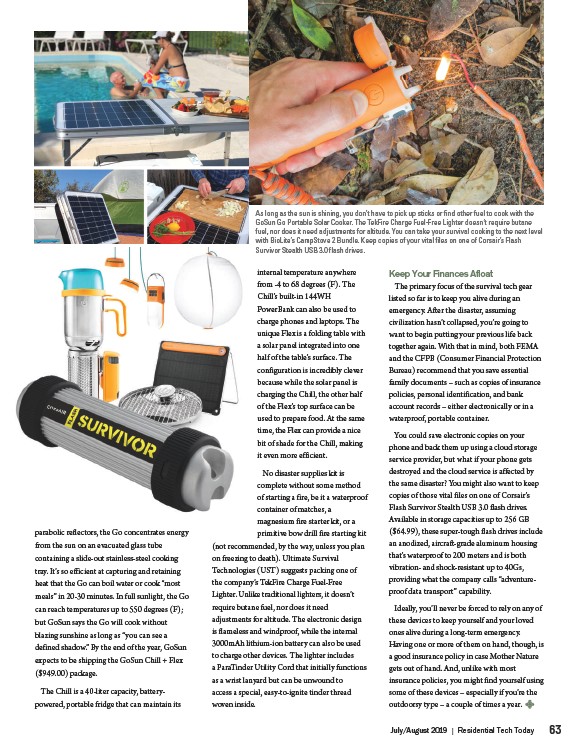
As long as the sun is shining, you don’t have to pick up sticks or find other fuel to cook with the
GoSun Go Portable Solar Cooker. The TekFire Charge Fuel-Free Lighter doesn’t require butane
fuel, nor does it need adjustments for altitude. You can take your survival cooking to the next level
with BioLite’s CampStove 2 Bundle. Keep copies of your vital files on one of Corsair’s Flash
Survivor Stealth USB 3.0 flash drives.
July/August 2019 | Residential Tech Today 63
parabolic reflectors, the Go concentrates energy
from the sun on an evacuated glass tube
containing a slide-out stainless-steel cooking
tray. It’s so efficient at capturing and retaining
heat that the Go can boil water or cook “most
meals” in 20-30 minutes. In full sunlight, the Go
can reach temperatures up to 550 degrees (F);
but GoSun says the Go will cook without
blazing sunshine as long as “you can see a
defined shadow.” By the end of the year, GoSun
expects to be shipping the GoSun Chill + Flex
($949.00) package.
The Chill is a 40-liter capacity, batterypowered,
portable fridge that can maintain its
internal temperature anywhere
from -4 to 68 degrees (F). The
Chill’s built-in 144WH
PowerBank can also be used to
charge phones and laptops. The
unique Flex is a folding table with
a solar panel integrated into one
half of the table’s surface. The
configuration is incredibly clever
because while the solar panel is
charging the Chill, the other half
of the Flex’s top surface can be
used to prepare food. At the same
time, the Flex can provide a nice
bit of shade for the Chill, making
it even more efficient.
No disaster supplies kit is
complete without some method
of starting a fire, be it a waterproof
container of matches, a
magnesium fire starter kit, or a
primitive bow drill fire starting kit
(not recommended, by the way, unless you plan
on freezing to death). Ultimate Survival
Technologies (UST) suggests packing one of
the company’s TekFire Charge Fuel-Free
Lighter. Unlike traditional lighters, it doesn’t
require butane fuel, nor does it need
adjustments for altitude. The electronic design
is flameless and windproof, while the internal
3000mAh lithium-ion battery can also be used
to charge other devices. The lighter includes
a ParaTinder Utility Cord that initially functions
as a wrist lanyard but can be unwound to
access a special, easy-to-ignite tinder thread
woven inside.
Keep Your Finances Afloat
The primary focus of the survival tech gear
listed so far is to keep you alive during an
emergency. After the disaster, assuming
civilization hasn’t collapsed, you’re going to
want to begin putting your previous life back
together again. With that in mind, both FEMA
and the CFPB (Consumer Financial Protection
Bureau) recommend that you save essential
family documents – such as copies of insurance
policies, personal identification, and bank
account records – either electronically or in a
waterproof, portable container.
You could save electronic copies on your
phone and back them up using a cloud storage
service provider, but what if your phone gets
destroyed and the cloud service is affected by
the same disaster? You might also want to keep
copies of those vital files on one of Corsair’s
Flash Survivor Stealth USB 3.0 flash drives.
Available in storage capacities up to 256 GB
($64.99), these super-tough flash drives include
an anodized, aircraft-grade aluminum housing
that’s waterproof to 200 meters and is both
vibration- and shock-resistant up to 40Gs,
providing what the company calls “adventureproof
data transport” capability.
Ideally, you’ll never be forced to rely on any of
these devices to keep yourself and your loved
ones alive during a long-term emergency.
Having one or more of them on hand, though, is
a good insurance policy in case Mother Nature
gets out of hand. And, unlike with most
insurance policies, you might find yourself using
some of these devices – especially if you’re the
outdoorsy type – a couple of times a year. x