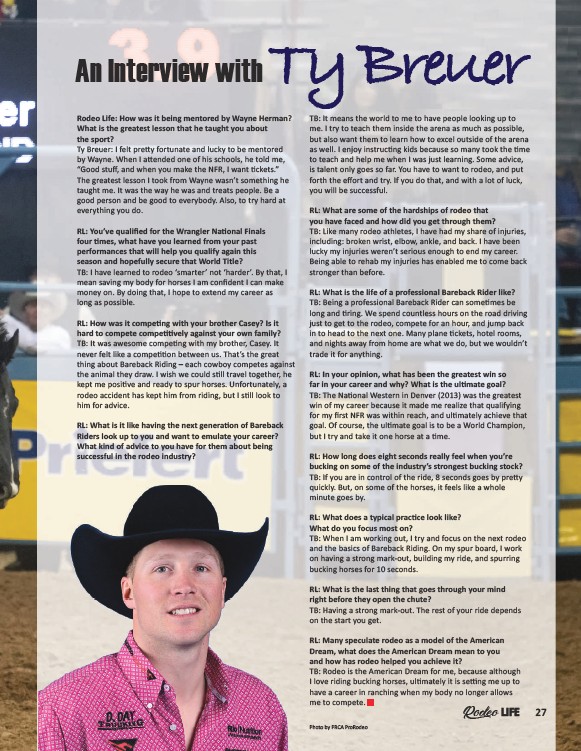
An Interview with Ty Breuer
Rodeo Life: How was it being mentored by Wayne Herman��
What is the greatest lesson that he taught you about
the sport��
Ty Breuer: I felt pre��y fortunate and lucky to be mentored
by ��ayne. ��hen I a��ended one of his schools, he told me,
“��ood stu��, and when you make the NFR, I want ��ckets.”
The greatest lesson I took from ��ayne wasn’t something he
taught me. It was the way he was and treats people. Be a
good person and be good to everybody. Also, to try hard at
everything you do.
RL: You’ve quali��ed for the Wrangler Na��onal Finals
four ��mes, what have you learned from your past
performances that will help you qualify again this
season and hopefully secure that World Title��
TB: I have learned to rodeo ‘smarter’ not ‘harder’. By that, I
mean saving my body for horses I am con��dent I can make
money on. By doing that, I hope to extend my career as
long as possible.
RL: How was it compe��ng with your brother Casey�� Is it
hard to compete compe����vely against your own family��
TB: It was awesome compe��ng with my brother, Casey. It
never felt like a compe����on between us. That’s the great
thing about Bareback Riding – each cowboy competes against
the animal they draw. I wish we could s��ll travel together, he
kept me posi��ve and ready to spur horses. Unfortunately, a
rodeo accident has kept him from riding, but I s��ll look to
him for advice.
RL: What is it like having the next genera��on of Bareback
Riders look up to you and want to emulate your career��
What kind of advice to you have for them about being
successful in the rodeo industry��
TB: It means the world to me to have people looking up to
me. I try to teach them inside the arena as much as possible,
but also want them to learn how to excel outside of the arena
as well. I en��oy instruc��ng kids because so many took the ��me
to teach and help me when I was ��ust learning. Some advice,
is talent only goes so far. You have to want to rodeo, and put
forth the e��ort and try. If you do that, and with a lot of luck,
you will be successful.
RL: What are some of the hardships of rodeo that
you have faced and how did you get through them��
TB: Like many rodeo athletes, I have had my share of in��uries,
including: broken wrist, elbow, ankle, and back. I have been
lucky my in��uries weren’t serious enough to end my career.
Being able to rehab my in��uries has enabled me to come back
stronger than before.
RL: What is the life of a professional Bareback Rider like��
TB: Being a professional Bareback Rider can some��mes be
long and ��ring. ��e spend countless hours on the road driving
��ust to get to the rodeo, compete for an hour, and ��ump back
in to head to the next one. Many plane ��ckets, hotel rooms,
and nights away from home are what we do, but we wouldn’t
trade it for anything.
RL: In your opinion, what has been the greatest win so
far in your career and why�� What is the ul��mate goal��
TB: The Na��onal ��estern in Denver ��2013�� was the greatest
win of my career because it made me realize that ��ualifying
for my ��rst NFR was within reach, and ul��mately achieve that
goal. Of course, the ul��mate goal is to be a ��orld Champion,
but I try and take it one horse at a ��me.
RL: How long does eight seconds really feel when you’re
bucking on some of the industry’s strongest bucking stock��
TB: If you are in control of the ride, 8 seconds goes by pre��y
��uickly. But, on some of the horses, it feels like a whole
minute goes by.
RL: What does a typical prac��ce look like��
What do you focus most on��
TB: ��hen I am working out, I try and focus on the next rodeo
and the basics of Bareback Riding. On my spur board, I work
on having a strong mark-out, building my ride, and spurring
bucking horses for 10 seconds.
RL: What is the last thing that goes through your mind
right before they open the chute��
TB: Having a strong mark-out. The rest of your ride depends
on the start you get.
RL: Many speculate rodeo as a model of the American
Dream, what does the American Dream mean to you
and how has rodeo helped you achieve it��
TB: Rodeo is the American Dream for me, because although
I love riding bucking horses, ul��mately it is se��ng me up to
have a career in ranching when my body no longer allows
me to compete.
Photo by PRCA ProRodeo
Rodeo LIFE 27