Going forward, the rollout of 5G cellular networks and Citizen’s
Broadband Radio Service (CBRS) spectrum at 3.5 GHz will
further enhance public safety and security communications.
Although high-speed applications
may garner a lot of the 5G attention,
low-energy, long-battery life applications
will be adopted as more
IoT applications come to market.
“Enterprises that want to prepare
for 5G today should deploy a lot
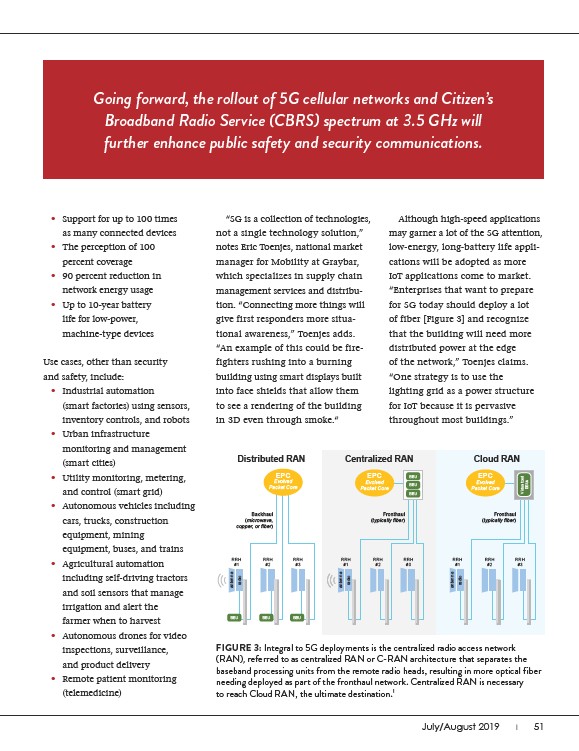
of fiber Figure 3 and recognize
that the building will need more
distributed power at the edge
of the network,” Toenjes claims.
“One strategy is to use the
lighting grid as a power structure
for IoT because it is pervasive
throughout most buildings.”
Distributed RAN Centralized RAN Cloud RAN
Virtualized
BBUs
July/August 2019 I 51
• Support for up to 100 times
as many connected devices
• The perception of 100
percent coverage
• 90 percent reduction in
network energy usage
• Up to 10-year battery
life for low-power,
machine-type devices
Use cases, other than security
and safety, include:
• Industrial automation
(smart factories) using sensors,
inventory controls, and robots
• Urban infrastructure
monitoring and management
(smart cities)
• Utility monitoring, metering,
and control (smart grid)
• Autonomous vehicles including
cars, trucks, construction
equipment, mining
equipment, buses, and trains
• Agricultural automation
including self-driving tractors
and soil sensors that manage
irrigation and alert the
farmer when to harvest
• Autonomous drones for video
inspections, surveillance,
and product delivery
• Remote patient monitoring
(telemedicine)
“5G is a collection of technologies,
not a single technology solution,”
notes Eric Toenjes, national market
manager for Mobility at Graybar,
which specializes in supply chain
management services and distribution.
“Connecting more things will
give first responders more situational
awareness,” Toenjes adds.
“An example of this could be fire-
fighters rushing into a burning
building using smart displays built
into face shields that allow them
to see a rendering of the building
in 3D even through smoke.“
EPC
Evolved
Packet Core
EPC
Evolved
Packet Core
Backhaul
(microwave,
copper, or fiber)
RRH
#1
RRH
#2
RRH
#3
Fronthaul
(typically fiber)
Fronthaul
(typically fiber)
RRH
#1
RRH
#2
RRH
#3
EPC
Evolved
Packet Core
RRH
#1
RRH
#2
RRH
#3
BBU
BBU
BBU
antenna
radio
BBU BBU BBU
antenna
radio
antenna
radio
FIGURE 3: Integral to 5G deployments is the centralized radio access network
(RAN), referred to as centralized RAN or C-RAN architecture that separates the
baseband processing units from the remote radio heads, resulting in more optical fiber
needing deployed as part of the fronthaul network. Centralized RAN is necessary
to reach Cloud RAN, the ultimate destination.1