of the validity of Montessori principles.
Here are some of them:
Give Them Unstructured Time;
Teach Life Skills, Teach Them
How to Think, Prepare Them for
Hard Work, Let Them Chart Their
Own Path, Normalize Struggle,
and Listen to Them.
When I was teaching a Mommy
and Me class, where moms
brought their infants with them
to learn how to interact with
them, we spent 20 minutes of
our one hour class just observing
the babies. The hardest thing for
most of the moms was to just
OBSERVE. They weren’t to talk
to them or move them or move
their toy closer to them. I was
astounded by how difficult it was
for so many moms to allow their
infants to learn to move independently,
to struggle to reach
a toy, or to interact with other
infants. This kind of behavior
doesn’t stop when they get older.
It just changes. For example,
elementary children have cell
phones and must check in when
they get on the school bus and
then when they get to school or
when they ride their bikes two
blocks down the street to play
at a friend’s house. I don’t even
want to get started on how parents
hover over adolescents!
Read this book. If you are overparenting,
it could help you stop.
It you are not, it will validate that
your way of parenting is a good
choice for you and your family.
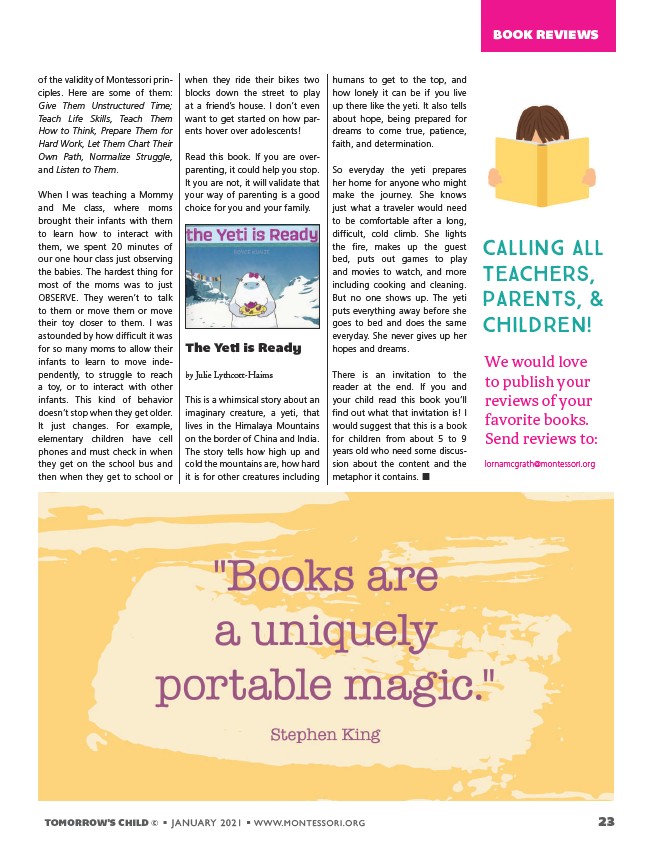
The Yeti is Ready
by Julie Lythcott-Haims
This is a whimsical story about an
imaginary creature, a yeti, that
lives in the Himalaya Mountains
on the border of China and India.
The story tells how high up and
cold the mountains are, how hard
it is for other creatures including
humans to get to the top, and
how lonely it can be if you live
up there like the yeti. It also tells
about hope, being prepared for
dreams to come true, patience,
faith, and determination.
So everyday the yeti prepares
her home for anyone who might
make the journey. She knows
just what a traveler would need
to be comfortable after a long,
difficult, cold climb. She lights
the fire, makes up the guest
bed, puts out games to play
and movies to watch, and more
including cooking and cleaning.
But no one shows up. The yeti
puts everything away before she
goes to bed and does the same
everyday. She never gives up her
hopes and dreams.
There is an invitation to the
reader at the end. If you and
your child read this book you’ll
find out what that invitation is! I
would suggest that this is a book
for children from about 5 to 9
years old who need some discussion
about the content and the
metaphor it contains. ��
BOOK REVIEWS
������
Calling all
teachers,
parents, &
children!
We would love
to publish your
reviews of your
favorite books.
Send reviews to:
lornamcgrath@montessori.org
TOMORROW'S CHILD © �� JANUARY 2021 �� WWW.MONTESSORI.ORG 23
/WWW.MONTESSORI.ORG
link