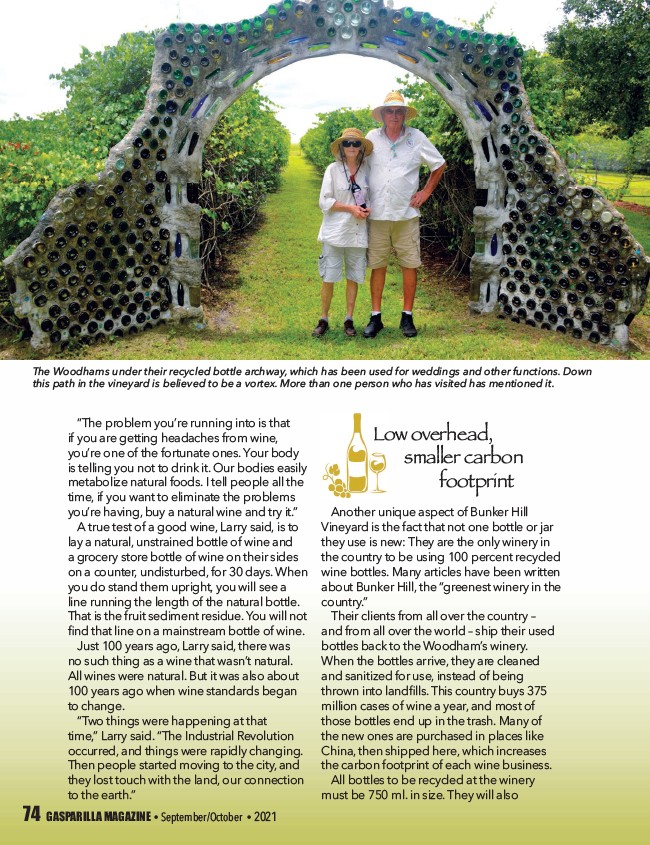
The Woodhams under their recycled bottle archway, which has been used for weddings and other functions. Down
this path in the vineyard is believed to be a vortex. More than one person who has visited has mentioned it.
“The problem you’re running into is that
if you are getting headaches from wine,
you’re one of the fortunate ones. Your body
is telling you not to drink it. Our bodies easily
metabolize natural foods. I tell people all the
time, if you want to eliminate the problems
you’re having, buy a natural wine and try it.”
A true test of a good wine, Larry said, is to
lay a natural, unstrained bottle of wine and
a grocery store bottle of wine on their sides
on a counter, undisturbed, for 30 days. When
you do stand them upright, you will see a
line running the length of the natural bottle.
That is the fruit sediment residue. You will not
fi nd that line on a mainstream bottle of wine.
Just 100 years ago, Larry said, there was
no such thing as a wine that wasn’t natural.
All wines were natural. But it was also about
100 years ago when wine standards began
to change.
“Two things were happening at that
time,” Larry said. “The Industrial Revolution
occurred, and things were rapidly changing.
Then people started moving to the city, and
they lost touch with the land, our connection
to the earth.”
Low overhead,
smaller carbon
footprint
Another unique aspect of Bunker Hill
Vineyard is the fact that not one bottle or jar
they use is new: They are the only winery in
the country to be using 100 percent recycled
wine bottles. Many articles have been written
about Bunker Hill, the “greenest winery in the
country.”
Their clients from all over the country –
and from all over the world – ship their used
bottles back to the Woodham’s winery.
When the bottles arrive, they are cleaned
and sanitized for use, instead of being
thrown into landfi lls. This country buys 375
million cases of wine a year, and most of
those bottles end up in the trash. Many of
the new ones are purchased in places like
China, then shipped here, which increases
the carbon footprint of each wine business.
All bottles to be recycled at the winery
must be 750 ml. in size. They will also
74 GASPARILLA MAGAZINE • September/October • 2021