70 Kidney Cancer Journal
T A B L E O F C O N T E N T S
Predictive Biomarkers in Kidney Cancer-
The Last Crusade or the Temple of Doom?
y mission as Guest Editor for this issue of the Kidney
Cancer Journal has a twofold purpose. The first is to
alert readers to the upcoming 17th International
Kidney Cancer Symposium (IKCS) in Miami, November 2-3-
a fantastic scientific program highlighting some of the outstanding
progress in conquering kidney cancer this year and
the exciting work expected in 2019. In my welcoming remarks
at this year’s scientific sessions, sponsored by the Kidney
Cancer Association, I will highlight an exciting agenda
with arguably the broadest spectrum of topics related to renal
cell carcinoma at any oncology symposium this year. The second message in
this Guest Editor’s Memo is to mention how one of our topics covered in this
issue touches upon a segment of the program at the IKCS—biomarkers.
Biomarkers continue to evolve in RCC; from protein markers to genomic
alterations and even recently, the stool microbiome. One of the planned sessions
at the IKCS meeting involves where we stand for prognostic and predictive
biomarkers including a discussion of the past, the present, and the future.
As the headline above suggests, the search for a reliable and predictive biomarker
has been exhaustive over the last decade and feels more like a plot line
to an Indiana Jones movie. How many meetings have you attended where
abstracts have proposed new exciting biomarkers yet validation studies became
trapped and failed to meet their promise or the investigators strayed from their
path and didn’t pursue clinical utility studies? Nonetheless, there are positive
signs that the “Quest for the Holy Grail” is beginning to move a bit closer to
the goal of identifying biomarkers to select therapy in view of a whole host of
clinical studies pursuing testable hypotheses.
The ultimate goal of a candidate biomarker is demonstration of validity
as an integral or integrated biomarker in the clinical trial setting. Several biomarker
driven trials are currently open in phase III trials evaluating non-clear
cell RCC using alterations in the MET pathway as either integral or integrated
biomarkers. SAVOIR explores the role of potent MET inhibitor savolitinib vs
sunitib in papillary RCC. In this trial, MET alterations (mutation or MET/HGF
amplication) serve as an integral biomarker dictating trial eligibility. PAPMET
(SWOG S1500) is looking at various MET inhibitors in all papillary RCC. In this
trial, MET alterations and papillary subtype (1, 2, or unclassified) by central
path review are used as integrated biomarkers with the hypothesis these influence
progression-free survival and response. These protocols build upon prior
work from the CREATE trial with crizotinib and a phase II trial of savolitinib
(NCT02127710). These larger phase III studies will be useful to determine if
this biomarker has clinical utility or is a forged relic.
Tumor sequencing is now readily available in house at some institutions or
Editorial Mission
The purpose of Kidney Cancer Journal is to serve as a comprehensive
resource of information for physicians regarding
advances in the diagnosis and treatment of renal cell carcinoma.
Content of the journal focuses on the impact of translational
research in oncology and urology and also provides a forum for
cancer patient advocacy. Kidney Cancer Journal is circulated to
medical oncologists, hematologist-oncologists, and urologists.
Editor-in-Chief
Robert A. Figlin, MD, FACP
Steven Spielberg Family Chair in Hematology Oncology
Professor of Medicine and Biomedical Sciences
Director, Division of Hematology Oncology
Deputy Director, Samuel Oschin Comprehensive
Cancer Institute
Cedars-Sinai Medical Center
Los Angeles, California
Medical Advisory Board
Michael B. Atkins, MD
Deputy Director
Lombardi Comprehensive Cancer Center
Professor of Oncology and Medicine,
Georgetown University Medical Center
Washington, DC
Ronald M. Bukowski, MD
Emeritus Staff & Consultant
CCF Taussig Cancer Center
Professor of Medicine
CCF Lerner College of Medicine of CWRU
Cleveland, Ohio
Robert J. Motzer, MD
Attending Physician
Memorial Sloan-Kettering
Cancer Center
New York, NY
Christopher G. Wood, MD, FACS
Douglas E. Johnson, MD Professorship
Professor & Deputy Chairman
Department of Urology
M.D. Anderson Cancer Center
Houston, Texas
Nurse Advisory Board
Nancy Moldawer, RN, MSN
Nursing Director
Cedars-Sinai Medical Center
Samuel Oschin Comprehensive Cancer Institute
Los Angeles, California
Laura Wood, RN, MSN, OCN
Renal Cancer Research Coordinator
Cleveland Clinic Taussig Cancer Center
Cleveland, Ohio
Patient Advocate
William P. Bro
Chief Executive Officer
Kidney Cancer Association
Publishing Staff
Stu Chapman, Executive Editor
Jenny Chapman, Director, Business Development
Gloria Catalano, Production Director
Michael McClain, Design Director
Business and Administration Office
333 E. 75th Street, Suite 5D
New York, NY 10021
Editorial Offices
Genitourinary Publishing
333 E. 75th Street, Suite 5D
New York, NY 10021
Tel: (516) 356-5006
© Copyright 2018 Genitourinary Publishing. All rights reserved.
None of the contents may be reproduced in any form without the
permission of the publisher.
About the Cover
Simulation suggests effect of combined immunotherapy and
targeted therapy on a colored scanning electron micrograph of
a kidney cancer cell. A broad spectrum of these combination
therapies, as depicted in the image, are undergoing study as part
of a synergistic strategy to address various pathways of renal cell
carcinoma. (Copyright, Photo Science Library)
71 Correspondence: Clarifying Checkpoint Inhibitor Treatment
Options in Non-clear Cell RCC
74 Journal Club
75 Medical Intelligence
76 Combination Immunotherapy and Targeted Therapy:
Will New Combinations Raise the Tail of the Survival Curve?
83 Evolving role of TKI monotherapy in front line metastatic ccRCC
88 The Landscape of Adjuvant Therapy: a Controversy in Search
of a Consensus
G U E S T E D I TOR ’ S M E M O
(continued on page 82)
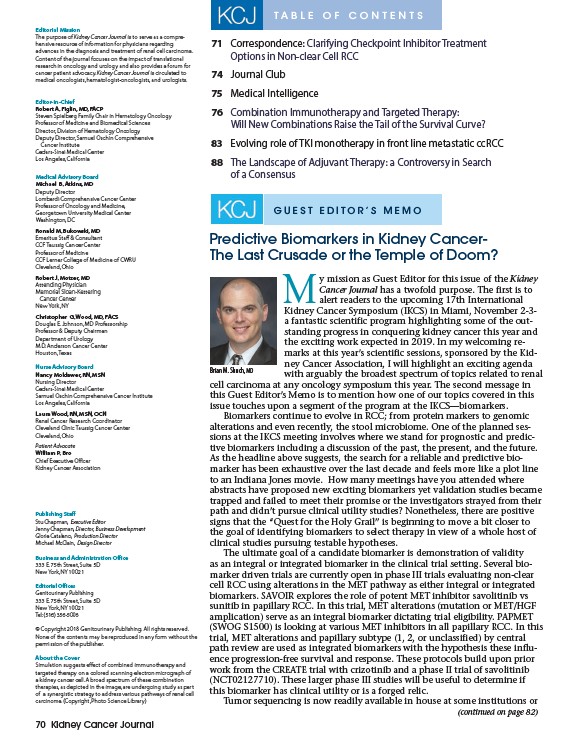
Brian M. Shuch, MD
M