LIFE IN THE SWASH ZONE:
MOLE CRABS
Last September, we took a look at Coquina clams, a common animal that
lives in the swash zone, where the water washes in and out after each wave.
Within our wide, flat intertidal zone, the swash zone is constantly shifting. It
moves down the beach front as the tide goes out, and migrates back up the
beach as the tide rises. With this constant shifting, any animals that prefer to
live here must also be mobile and able to keep up with their habitat moving
up and down the beach.
Along with Coquinas, one of the best examples of a swash zone animal is
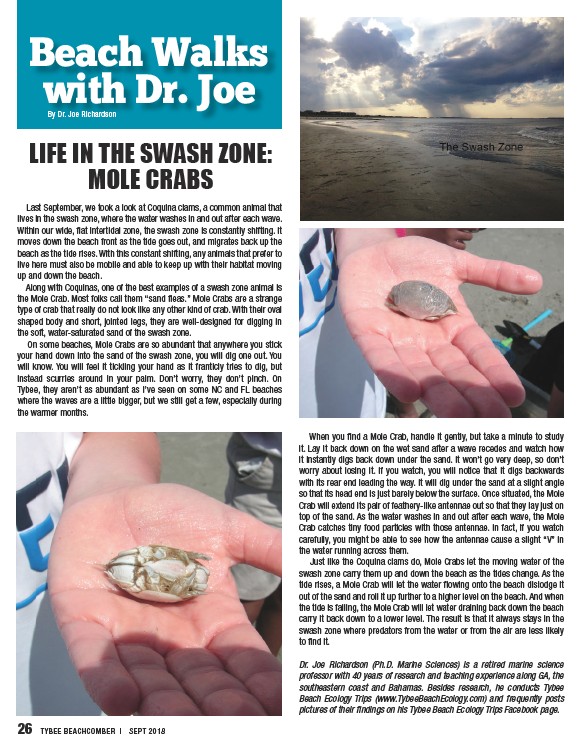
the Mole Crab. Most folks call them “sand fleas.” Mole Crabs are a strange
type of crab that really do not look like any other kind of crab. With their oval
shaped body and short, jointed legs, they are well-designed for digging in
the soft, water-saturated sand of the swash zone.
On some beaches, Mole Crabs are so abundant that anywhere you stick
your hand down into the sand of the swash zone, you will dig one out. You
will know. You will feel it tickling your hand as it franticly tries to dig, but
instead scurries around in your palm. Don’t worry, they don’t pinch. On
Tybee, they aren’t as abundant as I’ve seen on some NC and FL beaches
where the waves are a little bigger, but we still get a few, especially during
the warmer months.
26 TYBEE BEACHCOMBER | SEPT 2018
When you find a Mole Crab, handle it gently, but take a minute to study
it. Lay it back down on the wet sand after a wave recedes and watch how
it instantly digs back down under the sand. It won’t go very deep, so don’t
worry about losing it. If you watch, you will notice that it digs backwards
with its rear end leading the way. It will dig under the sand at a slight angle
so that its head end is just barely below the surface. Once situated, the Mole
Crab will extend its pair of feathery-like antennae out so that they lay just on
top of the sand. As the water washes in and out after each wave, the Mole
Crab catches tiny food particles with those antennae. In fact, if you watch
carefully, you might be able to see how the antennae cause a slight “V” in
the water running across them.
Just like the Coquina clams do, Mole Crabs let the moving water of the
swash zone carry them up and down the beach as the tides change. As the
tide rises, a Mole Crab will let the water flowing onto the beach dislodge it
out of the sand and roll it up further to a higher level on the beach. And when
the tide is falling, the Mole Crab will let water draining back down the beach
carry it back down to a lower level. The result is that it always stays in the
swash zone where predators from the water or from the air are less likely
to find it.
Dr. Joe Richardson (Ph.D. Marine Sciences) is a retired marine science
professor with 40 years of research and teaching experience along GA, the
southeastern coast and Bahamas. Besides research, he conducts Tybee
Beach Ecology Trips (www.TybeeBeachEcology.com) and frequently posts
pictures of their findings on his Tybee Beach Ecology Trips Facebook page.
Beach Walks
with Dr. Joe
By Dr. Joe Richardson
/(www.TybeeBeachEcology.com)