My Clearwater
Putting a Red Light on Red Tide
Clearwater Beach continues to be one of the best
beaches in the world. It’s a reputation the city of
Clearwater has worked hard to maintain and is
proud to showcase to hundreds of thousands of
visitors that wiggle their toes in our famous sugar sand every
year. But the main asset to this world-renowned beach is the
staff that helps keep it clean, maintained and most of all,
bright and beautiful.
Larry Bruce, parks and recreation supervisor, manages the
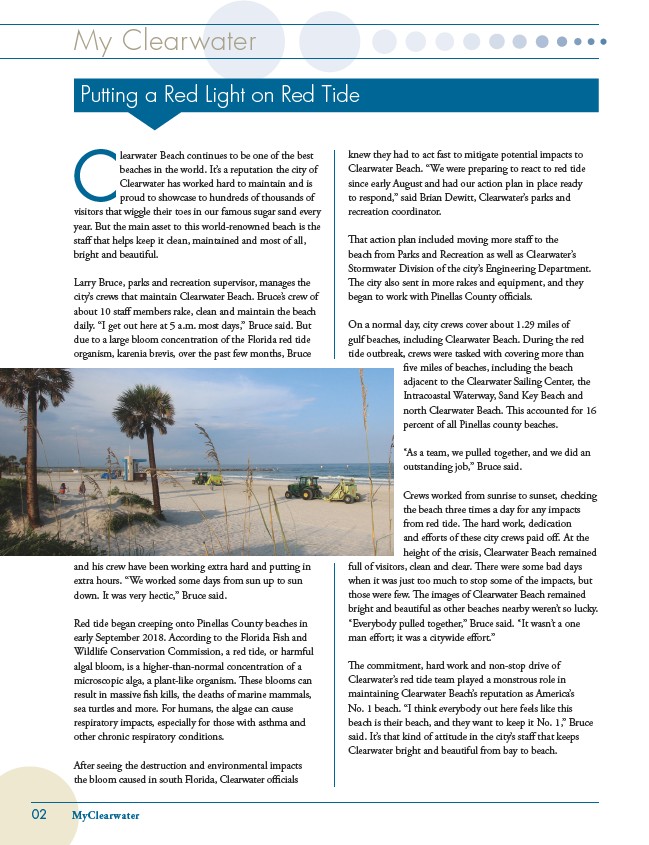
city’s crews that maintain Clearwater Beach. Bruce’s crew of
about 10 staff members rake, clean and maintain the beach
daily. “I get out here at 5 a.m. most days,” Bruce said. But
due to a large bloom concentration of the Florida red tide
organism, karenia brevis, over the past few months, Bruce
and his crew have been working extra hard and putting in
extra hours. “We worked some days from sun up to sun
down. It was very hectic,” Bruce said.
Red tide began creeping onto Pinellas County beaches in
early September 2018. According to the Florida Fish and
Wildlife Conservation Commission, a red tide, or harmful
algal bloom, is a higher-than-normal concentration of a
microscopic alga, a plant-like organism. These blooms can
result in massive fish kills, the deaths of marine mammals,
sea turtles and more. For humans, the algae can cause
respiratory impacts, especially for those with asthma and
other chronic respiratory conditions.
After seeing the destruction and environmental impacts
the bloom caused in south Florida, Clearwater officials
02 MyClearwater
knew they had to act fast to mitigate potential impacts to
Clearwater Beach. “We were preparing to react to red tide
since early August and had our action plan in place ready
to respond,” said Brian Dewitt, Clearwater’s parks and
recreation coordinator.
That action plan included moving more staff to the
beach from Parks and Recreation as well as Clearwater’s
Stormwater Division of the city’s Engineering Department.
The city also sent in more rakes and equipment, and they
began to work with Pinellas County officials.
On a normal day, city crews cover about 1.29 miles of
gulf beaches, including Clearwater Beach. During the red
tide outbreak, crews were tasked with covering more than
five miles of beaches, including the beach
adjacent to the Clearwater Sailing Center, the
Intracoastal Waterway, Sand Key Beach and
north Clearwater Beach. This accounted for 16
percent of all Pinellas county beaches.
“As a team, we pulled together, and we did an
outstanding job,” Bruce said.
Crews worked from sunrise to sunset, checking
the beach three times a day for any impacts
from red tide. The hard work, dedication
and efforts of these city crews paid off. At the
height of the crisis, Clearwater Beach remained
full of visitors, clean and clear. There were some bad days
when it was just too much to stop some of the impacts, but
those were few. The images of Clearwater Beach remained
bright and beautiful as other beaches nearby weren’t so lucky.
“Everybody pulled together,” Bruce said. “It wasn’t a one
man effort; it was a citywide effort.”
The commitment, hard work and non-stop drive of
Clearwater’s red tide team played a monstrous role in
maintaining Clearwater Beach’s reputation as America’s
No. 1 beach. “I think everybody out here feels like this
beach is their beach, and they want to keep it No. 1,” Bruce
said. It’s that kind of attitude in the city’s staff that keeps
Clearwater bright and beautiful from bay to beach.