1
18 NAUI Nitrox Diver
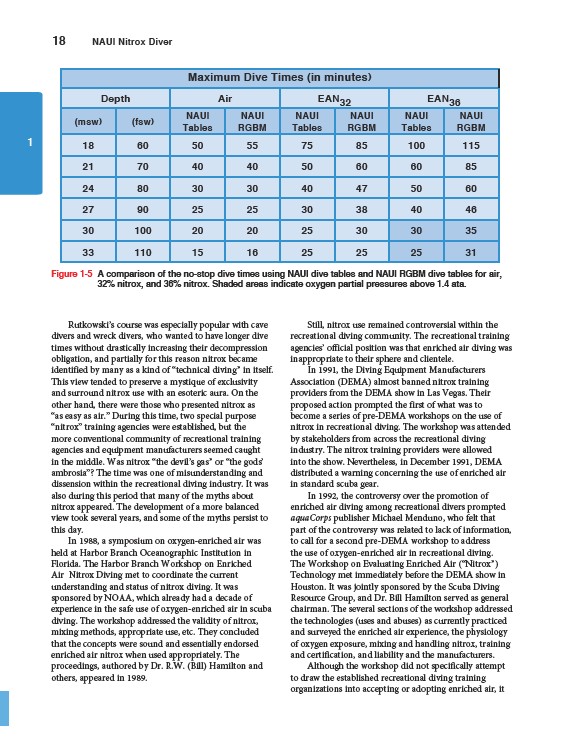
Maximum Dive Times (in minutes)
Depth Air EAN32 EAN36
Figure 1-5 A comparison of the no-stop dive times using NAUI dive tables and NAUI RGBM dive tables for air,
32% nitrox, and 36% nitrox. Shaded areas indicate oxygen partial pressures above 1.4 ata.
Rutkowski’s course was especially popular with cave
divers and wreck divers, who wanted to have longer dive
times without drastically increasing their decompression
obligation, and partially for this reason nitrox became
identified by many as a kind of “technical diving” in itself.
This view tended to preserve a mystique of exclusivity
and surround nitrox use with an esoteric aura. On the
other hand, there were those who presented nitrox as
“as easy as air.” During this time, two special purpose
“nitrox” training agencies were established, but the
more conventional community of recreational training
agencies and equipment manufacturers seemed caught
in the middle. Was nitrox “the devil’s gas” or “the gods’
ambrosia”? The time was one of misunderstanding and
dissension within the recreational diving industry. It was
also during this period that many of the myths about
nitrox appeared. The development of a more balanced
view took several years, and some of the myths persist to
this day.
In 1988, a symposium on oxygen-enriched air was
held at Harbor Branch Oceanographic Institution in
Florida. The Harbor Branch Workshop on Enriched
Air Nitrox Diving met to coordinate the current
understanding and status of nitrox diving. It was
sponsored by NOAA, which already had a decade of
experience in the safe use of oxygen-enriched air in scuba
diving. The workshop addressed the validity of nitrox,
mixing methods, appropriate use, etc. They concluded
that the concepts were sound and essentially endorsed
enriched air nitrox when used appropriately. The
proceedings, authored by Dr. R.W. (Bill) Hamilton and
others, appeared in 1989.
Still, nitrox use remained controversial within the
recreational diving community. The recreational training
agencies’ official position was that enriched air diving was
inappropriate to their sphere and clientele.
In 1991, the Diving Equipment Manufacturers
Association (DEMA) almost banned nitrox training
providers from the DEMA show in Las Vegas. Their
proposed action prompted the first of what was to
become a series of pre-DEMA workshops on the use of
nitrox in recreational diving. The workshop was attended
by stakeholders from across the recreational diving
industry. The nitrox training providers were allowed
into the show. Nevertheless, in December 1991, DEMA
distributed a warning concerning the use of enriched air
in standard scuba gear.
In 1992, the controversy over the promotion of
enriched air diving among recreational divers prompted
aquaCorps publisher Michael Menduno, who felt that
part of the controversy was related to lack of information,
to call for a second pre-DEMA workshop to address
the use of oxygen-enriched air in recreational diving.
The Workshop on Evaluating Enriched Air (“Nitrox”)
Technology met immediately before the DEMA show in
Houston. It was jointly sponsored by the Scuba Diving
Resource Group, and Dr. Bill Hamilton served as general
chairman. The several sections of the workshop addressed
the technologies (uses and abuses) as currently practiced
and surveyed the enriched air experience, the physiology
of oxygen exposure, mixing and handling nitrox, training
and certification, and liability and the manufacturers.
Although the workshop did not specifically attempt
to draw the established recreational diving training
organizations into accepting or adopting enriched air, it
(msw) (fsw)
NAUI
Tables
NAUI
RGBM
NAUI
Tables
NAUI
RGBM
NAUI
Tables
NAUI
RGBM
18 60 50 55 75 85 100 115
21 70 40 40 50 60 60 85
24 80 30 30 40 47 50 60
27 90 25 25 30 38 40 46
30 100 20 20 25 30 30 35
33 110 15 16 25 25 25 31