3
Chapter 3 The Physiology of Diving and Nitrox 39
However, if we dive too deep, for too long, and
then ascend too fast, the pressure gradient between the
dissolved nitrogen and the ambient pressure is too great
for proper, controlled offgassing, and excess released
nitrogen diffuses into the free-phase bubbles within the
body. Once the bubbles enlarge and begin to aggregate
they cause mechanical injury and also block the blood
flow to tissues, and the trauma presents as decompression
sickness.
The signs and symptoms of DCS vary greatly
depending on the location of the injury and the severity
of the case. They can range from simple excessive fatigue
to weakness and tingling in the limbs, limb and joint
pain and dysfunction, skin rashes and itching, vertigo,
loss of sensation, paralysis, and even death. Anyone with
a suspected case of DCS should be administered 100%
oxygen as immediate first aid, examined by a trained
physician, and if decompression sickness is suspected,
receive recompression chamber treatment. If in doubt,
treat! Untreated, even the mildest case of decompression
sickness may worsen over time, and permanent injury is
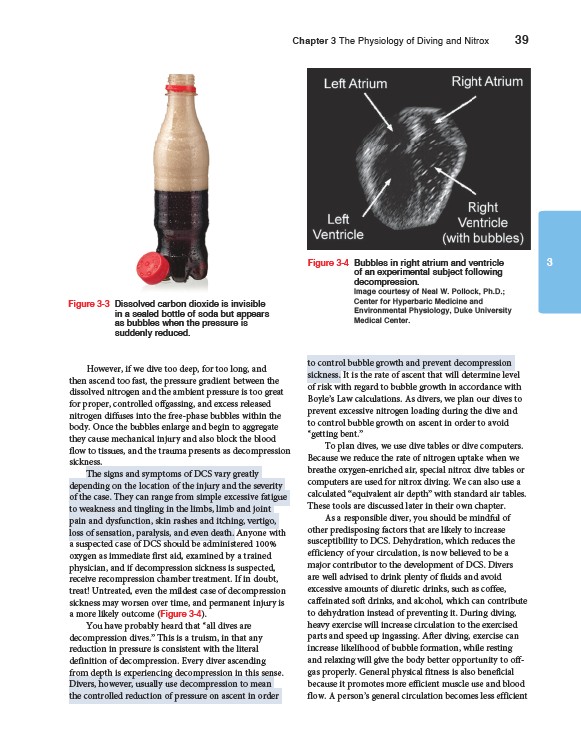
a more likely outcome (Figure 3-4).
You have probably heard that “all dives are
decompression dives.” This is a truism, in that any
reduction in pressure is consistent with the literal
definition of decompression. Every diver ascending
from depth is experiencing decompression in this sense.
Divers, however, usually use decompression to mean
the controlled reduction of pressure on ascent in order
to control bubble growth and prevent decompression
sickness. It is the rate of ascent that will determine level
of risk with regard to bubble growth in accordance with
Boyle’s Law calculations. As divers, we plan our dives to
prevent excessive nitrogen loading during the dive and
to control bubble growth on ascent in order to avoid
“getting bent.”
To plan dives, we use dive tables or dive computers.
Because we reduce the rate of nitrogen uptake when we
breathe oxygen-enriched air, special nitrox dive tables or
computers are used for nitrox diving. We can also use a
calculated “equivalent air depth” with standard air tables.
These tools are discussed later in their own chapter.
As a responsible diver, you should be mindful of
other predisposing factors that are likely to increase
susceptibility to DCS. Dehydration, which reduces the
efficiency of your circulation, is now believed to be a
major contributor to the development of DCS. Divers
are well advised to drink plenty of fluids and avoid
excessive amounts of diuretic drinks, such as coffee,
caffeinated soft drinks, and alcohol, which can contribute
to dehydration instead of preventing it. During diving,
heavy exercise will increase circulation to the exercised
parts and speed up ingassing. After diving, exercise can
increase likelihood of bubble formation, while resting
and relaxing will give the body better opportunity to offgas
properly. General physical fitness is also beneficial
because it promotes more efficient muscle use and blood
flow. A person’s general circulation becomes less efficient
Figure 3-3 Dissolved carbon dioxide is invisible
in a sealed bottle of soda but appears
as bubbles when the pressure is
suddenly reduced.
Figure 3-4 Bubbles in right atrium and ventricle
of an experimental subject following
decompression.
Image courtesy of Neal W. Pollock, Ph.D.;
Center for Hyperbaric Medicine and
Environmental Physiology, Duke University
Medical Center.