3
40 NAUI Nitrox Diver
with increasing age, and therefore older divers are
advised to dive more conservatively.
OXYGEN: THE GOOD AND THE BAD
In your beginning scuba course, your instructor may
have said: “At extreme depths, even the oxygen in the
air you breathe can become toxic, but this only happens
at depths far greater than recreational limits, so don’t
worry about it.” End of subject. Now you are learning to
dive with oxygen-enriched air, and oxygen toxicity and
oxygen safety are very real concerns.
Oxygen is vital to our being. It is our essential
life-support element. If we are deprived of oxygen, our
survival time is measured in just minutes. Still, our bodies
operate well only within a rather narrow range of oxygen
partial pressures. Too high an oxygen level can be just as
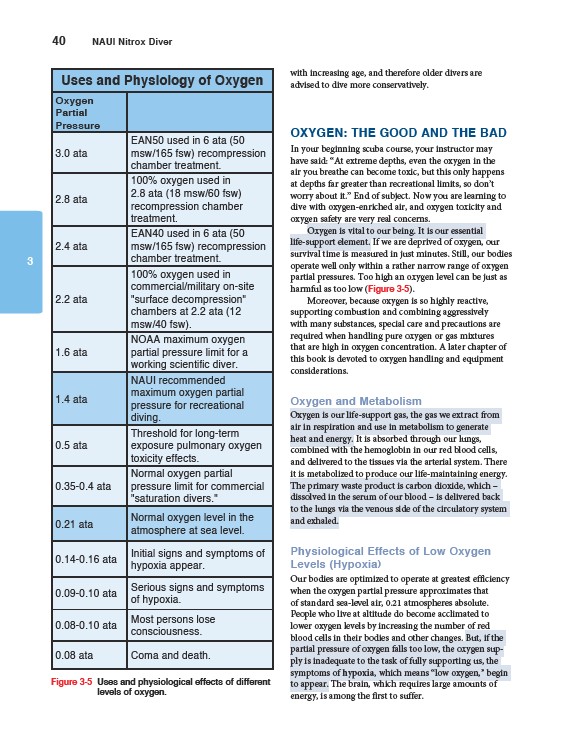
harmful as too low (Figure 3-5).
Moreover, because oxygen is so highly reactive,
supporting combustion and combining aggressively
with many substances, special care and precautions are
required when handling pure oxygen or gas mixtures
that are high in oxygen concentration. A later chapter of
this book is devoted to oxygen handling and equipment
considerations.
Oxygen and Metabolism
Oxygen is our life-support gas, the gas we extract from
air in respiration and use in metabolism to generate
heat and energy. It is absorbed through our lungs,
combined with the hemoglobin in our red blood cells,
and delivered to the tissues via the arterial system. There
it is metabolized to produce our life-maintaining energy.
The primary waste product is carbon dioxide, which –
dissolved in the serum of our blood – is delivered back
to the lungs via the venous side of the circulatory system
and exhaled.
Physiological Effects of Low Oxygen
Levels (Hypoxia)
Our bodies are optimized to operate at greatest efficiency
when the oxygen partial pressure approximates that
of standard sea-level air, 0.21 atmospheres absolute.
People who live at altitude do become acclimated to
lower oxygen levels by increasing the number of red
blood cells in their bodies and other changes. But, if the
partial pressure of oxygen falls too low, the oxygen supply
is inadequate to the task of fully supporting us, the
symptoms of hypoxia, which means “low oxygen,” begin
to appear. The brain, which requires large amounts of
energy, is among the first to suffer.
Uses and Physiology of Oxygen
Oxygen
Partial
Pressure
Figure 3-5 Uses and physiological effects of different
levels of oxygen.
3.0 ata
EAN50 used in 6 ata (50
msw/165 fsw) recompression
chamber treatment.
2.8 ata
100% oxygen used in
2.8 ata (18 msw/60 fsw)
recompression chamber
treatment.
2.4 ata
EAN40 used in 6 ata (50
msw/165 fsw) recompression
chamber treatment.
2.2 ata
100% oxygen used in
commercial/military on-site
"surface decompression"
chambers at 2.2 ata (12
msw/40 fsw).
1.6 ata
NOAA maximum oxygen
partial pressure limit for a
working scientific diver.
1.4 ata
NAUI recommended
maximum oxygen partial
pressure for recreational
diving.
0.5 ata
Threshold for long-term
exposure pulmonary oxygen
toxicity effects.
0.35-0.4 ata
Normal oxygen partial
pressure limit for commercial
"saturation divers."
0.21 ata
Normal oxygen level in the
atmosphere at sea level.
0.14-0.16 ata
Initial signs and symptoms of
hypoxia appear.
0.09-0.10 ata
Serious signs and symptoms
of hypoxia.
0.08-0.10 ata
Most persons lose
consciousness.
0.08 ata Coma and death.