5
58 NAUI Nitrox Diver
time. NOAA Nitrox I divers could, in effect, use standard
U.S. Navy air tables to plan and execute dives, if they
knew how to adjust for their equivalent air depth. In the
fourth edition of the NOAA Diving Manual (2001), two
sets of EAN32 tables were presented. An “Abbreviated”
version copies the NAUI EAN32 Dive Tables with a few
changes; an “Expanded” version presents a fuller set of
tables (with stage decompression information) modeled
on the U.S. Navy tables format.
When NOAA Nitrox II information was published
by NOAA in the fourth edition of the NOAA Diving
Manual, an Abbreviated version and an Expanded
version of tables were presented for EAN36, similar to
the EAN32 tables. Although the correspondence is not
as striking as it is with NOAA Nitrox I, still for actual
depths from 21 meters (70 feet) to 33 meters (110 feet),
the NOAA Nitrox II tables corresponded to dives that
were two increments 6 meters (20 feet) shallower on the
U.S. Navy air tables. For example, an air diver diving
to 21 meters (70 feet) using the U.S. Navy air tables
would have a no-decompression limit of 50 minutes
and an ending repetitive letter group of “J.” An EAN36
diver could descend to 27 meters (90 feet) for that same
50-minute bottom time and ending letter group. An air
diver descending to 27 meters (90 feet) would have only
30 minutes of no-decompression dive time. If an air diver
were to dive 50 minutes at 27 meters (90 feet), he would
face a required decompression stop of 18 minutes at
3 meters (10 feet) and would emerge as an “L” diver.
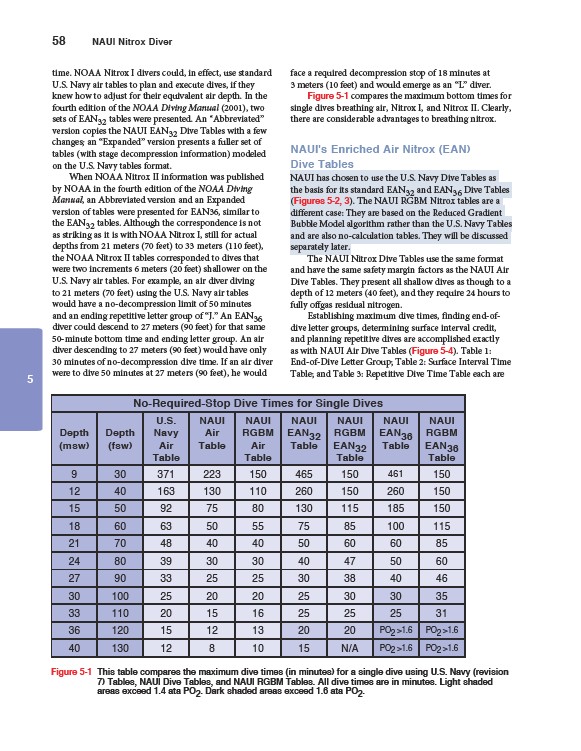
Figure 5-1 compares the maximum bottom times for
single dives breathing air, Nitrox I, and Nitrox II. Clearly,
there are considerable advantages to breathing nitrox.
NAUI's Enriched Air Nitrox (EAN)
Dive Tables
NAUI has chosen to use the U.S. Navy Dive Tables as
the basis for its standard EAN32 and EAN36 Dive Tables
(Figures 5-2, 3). The NAUI RGBM Nitrox tables are a
different case: They are based on the Reduced Gradient
Bubble Model algorithm rather than the U.S. Navy Tables
and are also no-calculation tables. They will be discussed
separately later.
The NAUI Nitrox Dive Tables use the same format
and have the same safety margin factors as the NAUI Air
Dive Tables. They present all shallow dives as though to a
depth of 12 meters (40 feet), and they require 24 hours to
fully offgas residual nitrogen.
Establishing maximum dive times, finding end-ofdive
letter groups, determining surface interval credit,
and planning repetitive dives are accomplished exactly
as with NAUI Air Dive Tables (Figure 5-4). Table 1:
End-of-Dive Letter Group; Table 2: Surface Interval Time
Table; and Table 3: Repetitive Dive Time Table each are
No-Required-Stop Dive Times for Single Dives
Figure 5-1 This table compares the maximum dive times (in minutes) for a single dive using U.S. Navy (revision
7) Tables, NAUI Dive Tables, and NAUI RGBM Tables. All dive times are in minutes. Light shaded
areas exceed 1.4 ata PO2. Dark shaded areas exceed 1.6 ata PO2.
Depth
(msw)
Depth
(fsw)
U.S.
Navy
Air
Table
NAUI
Air
Table
NAUI
RGBM
Air
Table
NAUI
EAN32
Table
NAUI
RGBM
EAN32
Table
NAUI
EAN36
Table
NAUI
RGBM
EAN36
Table
9 30 371 223 150 465 150 461 150
12 40 163 130 110 260 150 260 150
15 50 92 75 80 130 115 185 150
18 60 63 50 55 75 85 100 115
21 70 48 40 40 50 60 60 85
24 80 39 30 30 40 47 50 60
27 90 33 25 25 30 38 40 46
30 100 25 20 20 25 30 30 35
33 110 20 15 16 25 25 25 31
36 120 15 12 13 20 20 PO2 >1.6 PO2 >1.6
40 130 12 8 10 15 N/A PO2 >1.6 PO2 >1.6