1. 1 GbE to 10 GbE to 40 GbE 2. 25 GbE to 100 GbE and beyond
3. Up to 150 m 4. 500 m to 2 km
April/May/June 2020 I 11
Enterprise Hyperscale
5. Multimode meets most existing needs
(generally up to 40 GbE)
6. Singlemode may be used to provide
����������������������������
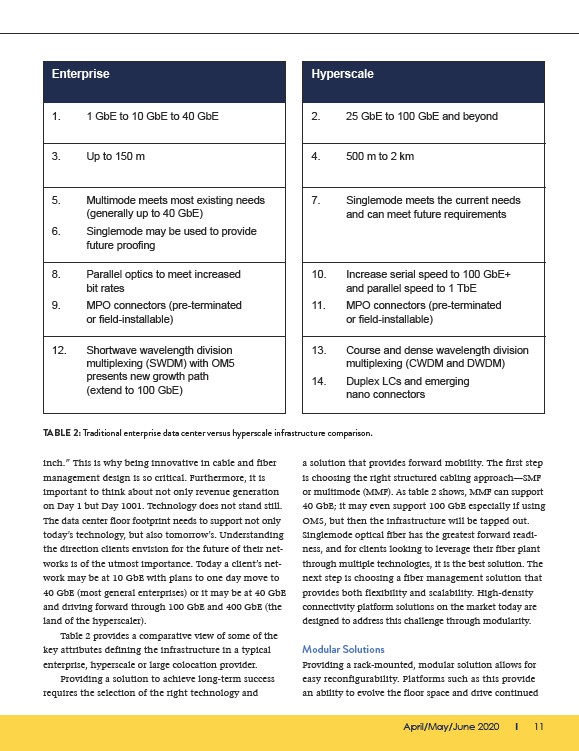
TABLE 2: Traditional enterprise data center versus hyperscale infrastructure comparison.
inch.” This is why being innovative in cable and fiber
management design is so critical. Furthermore, it is
important to think about not only revenue generation
on Day 1 but Day 1001. Technology does not stand still.
The data center floor footprint needs to support not only
today’s technology, but also tomorrow’s. Understanding
the direction clients envision for the future of their networks
is of the utmost importance. Today a client’s network
may be at 10 GbE with plans to one day move to
40 GbE (most general enterprises) or it may be at 40 GbE
and driving forward through 100 GbE and 400 GbE (the
land of the hyperscaler).
Table 2 provides a comparative view of some of the
key attributes defining the infrastructure in a typical
enterprise, hyperscale or large colocation provider.
Providing a solution to achieve long-term success
requires the selection of the right technology and
7. Singlemode meets the current needs
and can meet future requirements
8. Parallel optics to meet increased
bit rates
9. MPO connectors (pre-terminated
����������������������������������������
10. Increase serial speed to 100 GbE+
and parallel speed to 1 TbE
11. MPO connectors (pre-terminated
����������������������������������������
12. Shortwave wavelength division
multiplexing (SWDM) with OM5
presents new growth path
(extend to 100 GbE)
13. Course and dense wavelength division
multiplexing (CWDM and DWDM)
14. Duplex LCs and emerging
nano connectors
a solution that provides forward mobility. The first step
is choosing the right structured cabling approach—SMF
or multimode (MMF). As table 2 shows, MMF can support
40 GbE; it may even support 100 GbE especially if using
OM5, but then the infrastructure will be tapped out.
Singlemode optical fiber has the greatest forward readiness,
and for clients looking to leverage their fiber plant
through multiple technologies, it is the best solution. The
next step is choosing a fiber management solution that
provides both flexibility and scalability. High-density
connectivity platform solutions on the market today are
designed to address this challenge through modularity.
Modular Solutions
Providing a rack-mounted, modular solution allows for
easy reconfigurability. Platforms such as this provide
an ability to evolve the floor space and drive continued